Observation of a_0^0 (980)-f_0 (980) Mixing at BESIII
The first observation of a_0^0 (980)-f_0 (980) mixing at BESIII experiment was published recently in Physical Review Letters as a letter of “Editors’ Suggestion”.
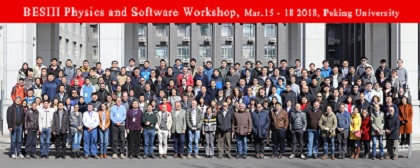
Workshop in Spring of 2018, March 15 – 18, 2018, Beijing Univ., Beijing
BESIII Workshop in Spring of 2018, March 15 – 18, 2018, Beijing Univ., Beijing. Prof. Yuan Changzheng, from the Institute of High Energy Physics (IHEP), has been elected the new spokesperson of the BESIII Collaboration. The announcement was made at the BESIII Physics and Software Workshop, which was held from March 15 to 18 at Peking University.
BESIII Collaboration 2016 Summer Meeting Held in Wuhan
The BESIII Collaboration 2016 Summer Meeting was held from June 13th to 17th at Central China NormalUniversity(CCNU), Wuhan. The meeting attracted around 200 scholars and students from 49 research institutions in the United States, German, Italy, Sweden, Turkey, Korea, Mongolia and China.ProfessorLuciano Maiani, the former Director-General of CERN, was invited to attend the meeting as a special guest.
The first direct measurement on the Λc+ decays at the threshold
The Center for Research on Intelligent Perception and Computing, founded in 1998 by Prof. Tieniu Tan, is subordinated to NLPR (National Laboratory of Pattern Recognition). It has 18 research faculties.
Zc(3900) is on the top of the "Highlights of the Year"
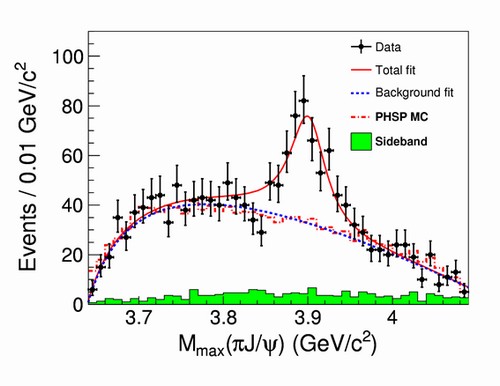
Quarks come in twos and threes—or so nearly every experiment has told us. This summer, the BESIII Collaboration in China and the Belle Collaboration in Japan reported they had sorted through the debris of high-energy electron-positron collisions and seen a mysterious particle that appeared to contain four quarks. Though other explanations for the nature of the particle, dubbed Zc(3900), are possible, the “tetraquark” interpretation may be gaining traction: BESIII has since seen a series of other particles that appear to contain four quarks.
Observation of a charged charmoniumlike structure at BESIII
An international team of scientists that operate the BESIII Experiment at the Beijing Electron Positron Collider in China recently began a series of specialized studies aiming at an understanding of the anomalous "Y(4260)" particle. As a striking and unexpected first observation from these new studies, the collaboration has reported that the Y(4260) particle in fact decays to a new, and perhaps even more mysterious, particle that they named the "Zc(3900).”