Positron Annihilation Probe Reveals Chemical Short-Range Order in Multi‑Principal‑Element Alloys
To address the longstanding challenge of characterizing chemical short‑range order (SRO) in multi‑principal‑element alloys (MPEAs), the research groups led by Prof. CAO Xingzhong at the Institute of High Energy Physics of Chinese Academy of Sciences (IHEP, CAS) and Prof. LU Yiping at the Dalian University of Technology developed an accurate identification methodology based on positron annihilation spectroscopy. The work is published under the title "Positron annihilation in multiprincipal element alloys for the identification of chemical short‑range‑order structures" in Physical Review Letters [Phys. Rev. Lett. 137, 026101 (2026)].
Owing to their exceptional mechanical properties, thermal stability, and radiation tolerance, MPEAs have emerged as a frontier in advanced structural materials. At the atomic scale, the alloy elements often deviate from random mixing, giving rise to chemically ordered regions with specific structural features—the so‑called short‑range order. These nanoscale local ordered configurations possess crucial roles on deformation mechanisms, phase transformation kinetics, and functional properties of MPEAs. Nevertheless, the intrinsically small spatial extent, chemically complex local environments, and high structural similarity to the matrix pose formidable obstacles to achieving statistically-representative, precise identification of SRO. Resolving this bottleneck is essential for the rational design and reliable property assessment of high‑performance alloys.
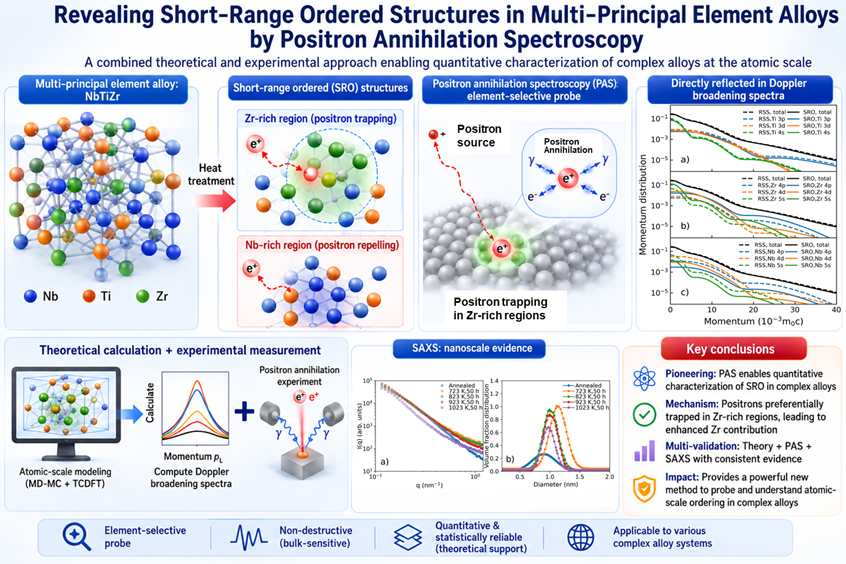
Figure 1. Schematic of characterizing SRO structures by using PAS.
Positrons—the antiparticles of electrons—annihilate upon encountering an electron, converting their combined rest mass into gamma-ray photons while conserving energy, momentum, and charge. Positron annihilation spectroscopy (PAS) exploits this fundamental process as a non-destructive, highly sensitive probe of atomic-scale microstructures. The underlying principle is that a positron implanted into a solid thermalizes and subsequently acts as a local probe of its electronic environment: the annihilation characteristics—most notably the positron lifetime and the Doppler broadening of the 511‑keV annihilation line—are dictated by the local electron density and momentum distribution at the annihilation site. By precisely measuring these observables, one can extract quantitative information about open‑volume defects, chemical composition fluctuations, and nanoscale inhomogeneities. PAS thus provides a uniquely sensitive and statistically representative quantum probe for interrogating local electronic structures and atomic arrangements in complex condensed‑matter systems. Currently, the application of PAS is undergoing a significant expansion from conventional vacancy‑type defect characterization toward the identification of complex, multi‑component local environments. Elevating the sensitivity of this technique to the level of SRO signatures not only provides robust experimental support for establishing structure–property relationships in MPEAs, but also holds substantial academic value for developing advanced characterization methodologies and constructing frameworks of multi‑scale microstructural analysis.
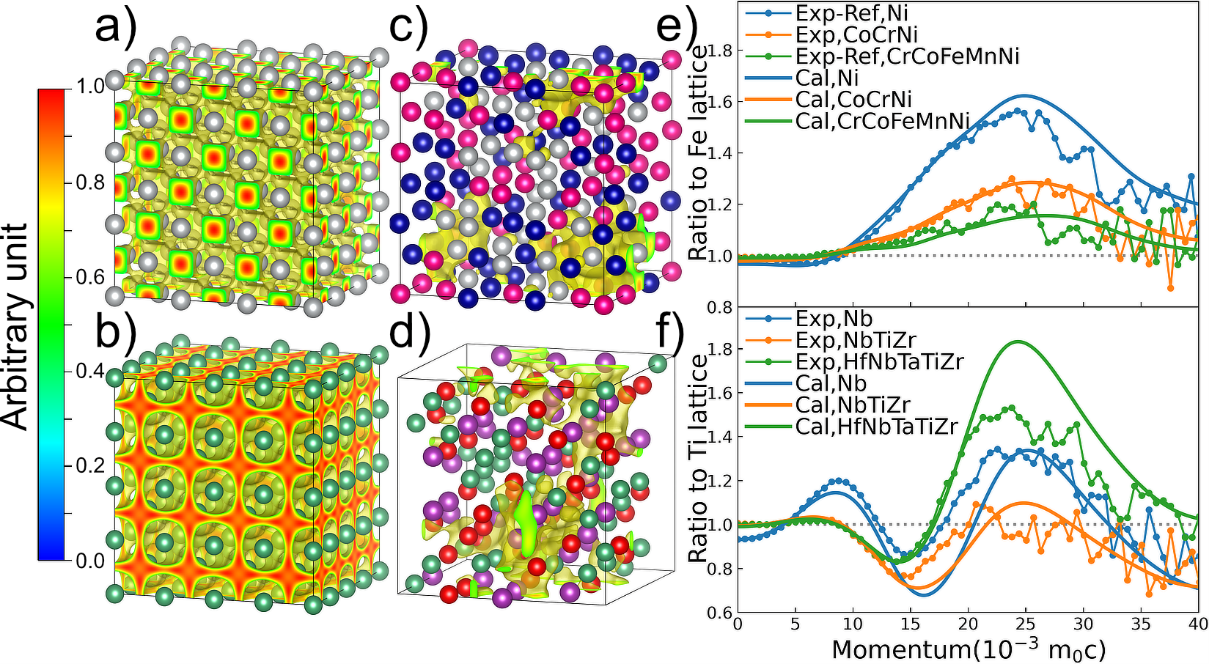
Figure 2. Positron states and Doppler broadening spectra in MPEA lattices.
To precisely identify the SRO structures, this study established an analytical framework that integrates positron annihilation spectroscopy with multi‑scale theoretical modeling. Taking the equiatomic NbTiZr MPEA as a model system, the work systematically unraveled how atomic‑nano scale ordered structures modulate positron behaviors. The two‑component density functional theory (TCDFT) was employed to elucidate the "semi‑localized" distribution characteristics of positrons in complex alloy lattices. This theoretical tool enables atomistic resolution of the influences of lattice distortion and local charge transfer on positron responses, thereby providing the essential physical basis for discerning element‑selective annihilation induced by SRO. Experimentally, it was found that the degree of SRO in the NbTiZr system intensifies with decreasing aging temperature, and the resulting Nb‑ and Zr‑enriched clusters substantially modify the local electron momentum distribution, leaving a distinct "physical fingerprint" in the Doppler broadening spectra. Complementary synchrotron small‑angle X‑ray scattering (SAXS) measurements corroborate the accuracy of positron annihilation in capturing nanoscale chemical fluctuations.
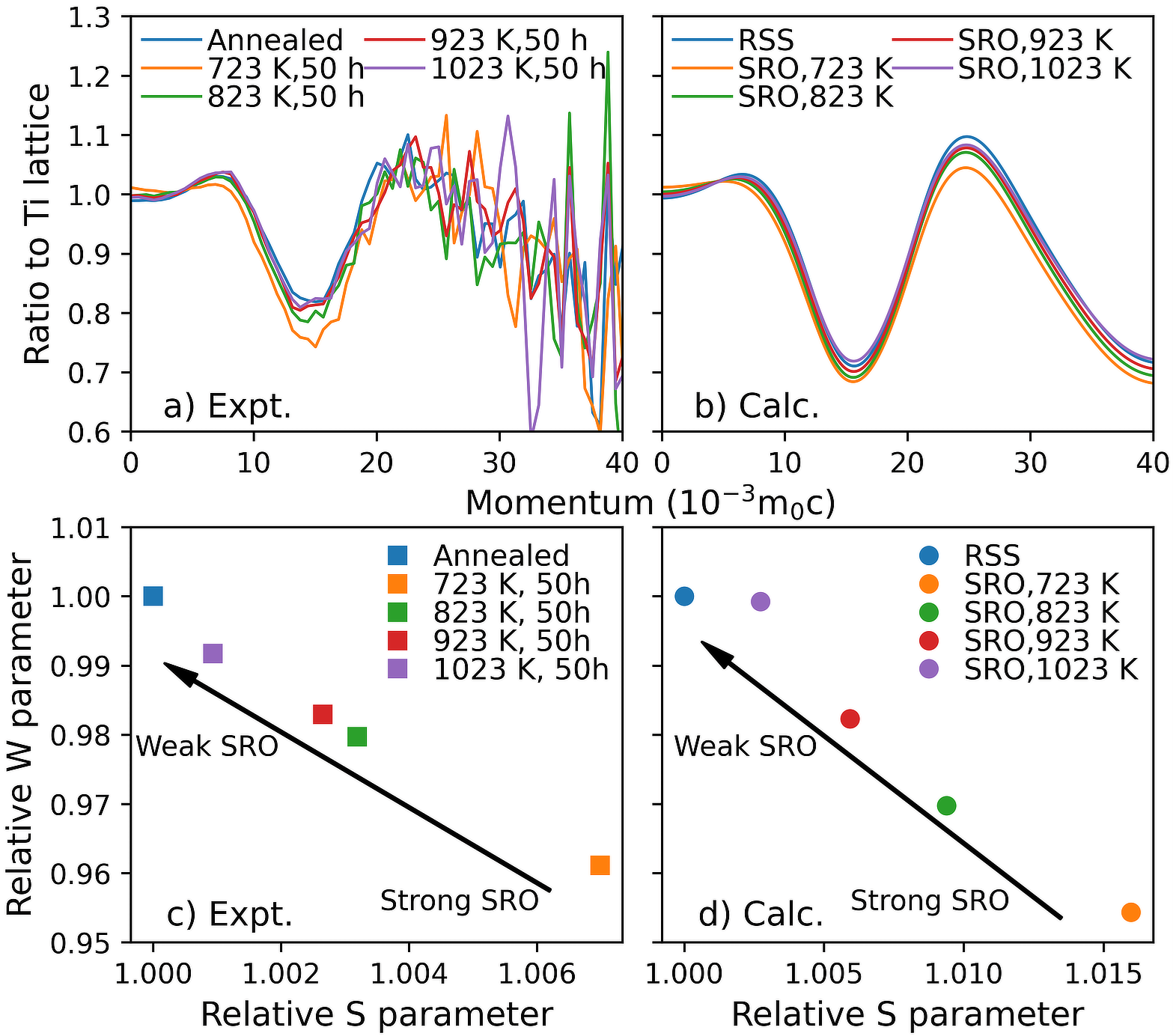
Figure 3. Comparison of theoretical and experimental positron annihilation Doppler broadening spectra in SRO structures of NbTiZr.
This work not only revealed the evolution of SRO in NbTiZr system, but also achieved a methodological milestone: it extended the application of PAS from conventional vacancy‑defect probing to the precise identification of atomic‑scale chemical ordering in complex concentrated systems, thereby establishing a statistically robust quantum‑probe route for advanced materials characterization.
Dr. YANG Qigui at the Multi‑Disciplinary Research Center, IHEP, is the first author of the paper, with Prof. CAO Xingzhong as the corresponding author. Ms. WANG Qianqian, a PhD candidate at the School of Materials Science and Engineering, Dalian University of Technology, is the co‑first author, and Prof. LU Yiping is the co‑corresponding author.