First Physics Result of the Jiangmen Underground Neutrino Observatory Published in Nature
On June 10, JUNO's first physics result titled "Measurement of reactor neutrino oscillation with the first JUNO data" was formally released as a cover article in Nature. Based on the analysis of valid data collected over 59 days from August 26 to November 2, 2025, the high-precision measurement of the two key oscillation parameters, reducing the associated uncertainties by a factor of 1.6 compared to the combined experimental results in the past decades. The reviewer gave high praise: These results not only validate the detector performance and analysis methodology but also establish JUNO as a key player in the emerging precision era of neutrino oscillation physics, with direct implications for tests of the three-flavor paradigm, global oscillation fits, and future determinations of the neutrino mass ordering. Nature also published an accompanying article of News & Views, noting that "Understanding the behaviour of neutrinos is paramount to developing a complete description of matter and forces at the smallest scale. This first analysis builds confidence that the detector will be able to determine the mass ordering. This first result from JUNO marks the dawn of the next era of precise neutrino oscillation measurements, and it promises fresh insights into the properties of these mysterious fundamental particles."
In addition, the paper on JUNO's detector performance was published as a cover article in Chinese Physics C this April. Professor Arthur McDonald, who was awarded the 2015 Nobel Prize in Physics for the discovery of solar neutrino oscillation, remarked on the paper: JUNO has successfully met its design objectives, achieving exceptional radiopurity, energy resolution, and detector stability. The experiment is fully operational and ready to pursue its ambitious physics goals, including determining the NMO, studying neutrino oscillation parameters, detecting neutrinos from various sources, and exploring physics beyond the Standard Model for Elementary Particles.
Neutrinos have no electrical charge and very little mass, with very little interaction with matter. A typical neutrino can pass through normal matter unimpeded, making the detection of neutrinos very difficult. Among all elementary particles, neutrinos are the least known.
JUNO began data taking in August 2025, with the primary physics goal to determine the mass ordering of neutrinos. JUNO will also be able to measure three out of the six neutrino mixing parameters to a precision better than 1%, and conduct studies on supernova neutrinos, geo-neutrinos, solar neutrinos, atmospheric neutrinos, etc.
700 meters underground, right at the heart of JUNO, stands a central liquid‑scintillator detector with an unprecedentedly large effective mass of 20,000 tons, housed at the center of a 44‑meter‑deep water pool. A 41.1‑meter‑diameter stainless steel truss supports the 35.4‑meter acrylic sphere, the scintillator, 20,000 20‑inch photomultiplier tubes (PMTs), 25,600 3‑inch PMTs, front‑end electronics, cabling, anti‑magnetic compensation coils, and optical panels. All PMTs operate simultaneously to capture scintillation light from neutrino interactions and convert them to electrical signals. JUNO can measure precisely energies of neutrinos upon their interaction to determine oscillation parameters.
JUNO has been running smoothly for nine months to date. As data accumulates, numerous new results will be released sequentially starting from this summer, gradually unlocking new mysteries of neutrinos.

Fig 1. The cover of Nature (Vol. 654, No. 8118) (Credit: JUNO Collaboration)

Fig 2. The cover of Chinese Physics C (Issue 4, 2026) (Credit: JUNO Collaboration)
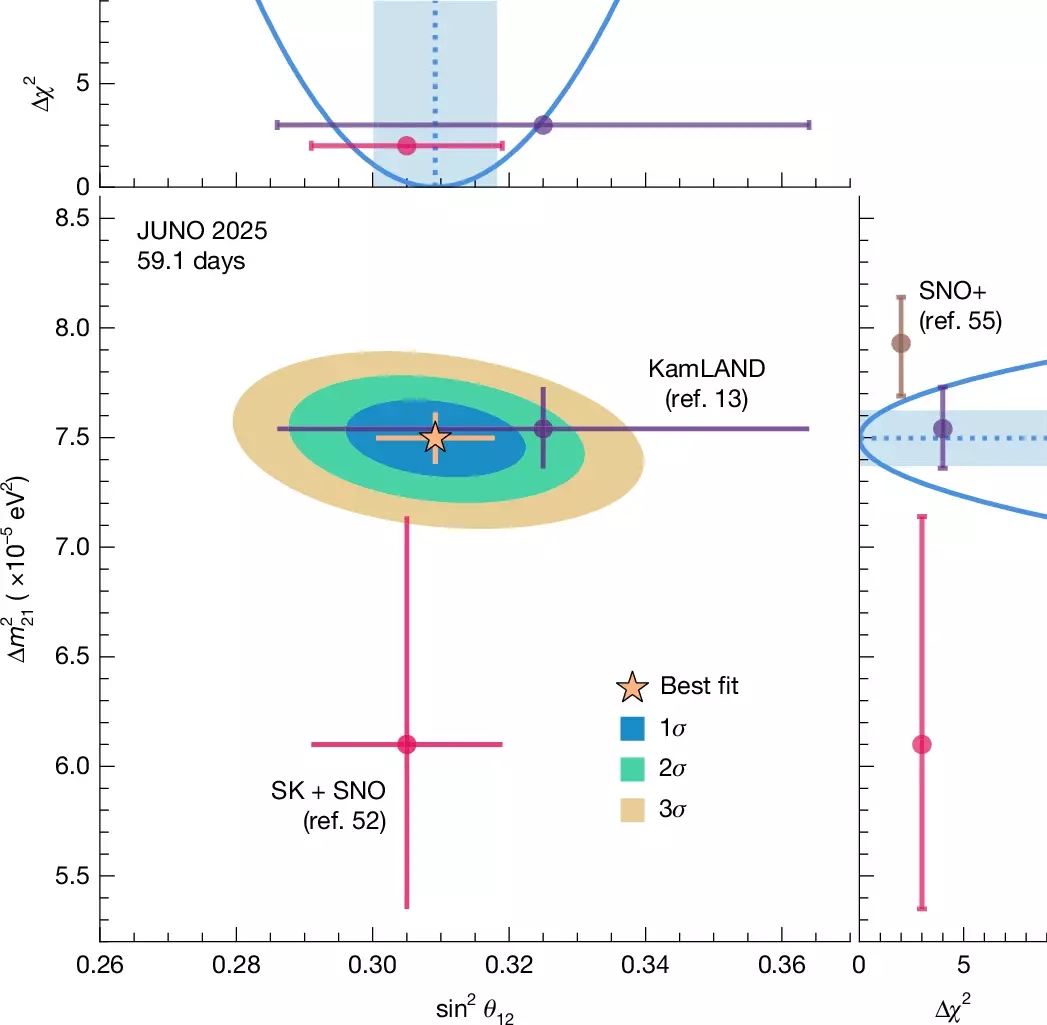
Fig 3. The first physics result of JUNO (Credit: JUNO Collaboration)
Paper link: https://doi.org/10.1038/s41586-026-10538-z
Related News

JUNO Holds 17th Collaboration Meeting Online
02-10,21
The 17th International Collaboration Meeting of the Jiangmen Underground Neutrino Observatory (JU...
Acceptance Test of All 20-inch PMTs for JUNO Completed
01-18,21
Acceptance testing of all 20-inch photomultiplier tubes (PMTs) for the JUNO experiment was comple...