LHAASO Discovers 'Aquila Booster', Challenging Theoretical Limits of Particle Acceleration in PWNe
The Large High Altitude Air Shower Observatory (LHAASO), has detected PeV (10¹⁵ eV) gamma-ray emission from a pulsar wind nebula powered by PSR J1849-0001 in the constellation Aquila. The observation reveals that the particle acceleration efficiency of this celestial structure approaches or even exceeds the theoretical limits allowed under ideal magnetohydrodynamic conditions, posing a serious challenge to the classical theory of particle acceleration in pulsar wind nebulae. The paper was published in Nature Astronomy on April 13. The corresponding authors are Prof. LIU Ruoyu, Dr. WANG Kai, and doctoral student TONG Chaonan from Nanjing University, as well as Prof. CHEN Songzhan and Assoc. Prof. WANG Lingyu from the Institute of High Energy Physics of the Chinese Academy of Sciences.
A pulsar wind nebula is a spectacular, high-energy celestial structure formed when a pulsar—a rapidly rotating, magnetized neutron star—expels a wind of charged particles moving at nearly the speed of light (known as a "pulsar wind") into the surrounding space, where it violently collides with the ambient medium. For a long time, the Crab Nebula—driven by the most luminous spin-down-powered pulsar in the Milky Way—has been regarded as a "standard candle" in the field of high-energy astrophysics. Previously, by detecting PeV-scale gamma rays originating from the Crab Nebula, LHAASO inferred that the particle acceleration efficiency within the nebula reaches at least 16% of the theoretical limit. This finding firmly established the Crab Nebula's status as an extreme PeVatron, a PeV-scale particle accelerator, sparking widespread interest and discussion within the scientific community and being hailed as one of the two most surprising discoveries regarding the Crab Nebula in the gamma-ray band.
This LHAASO study focuses on another pulsar wind nebula system, PSR J1849-0001 (see Figure 1). Located in the constellation Aquila, PSR J1849-0001 has a spin-down luminosity approximately 50 times lower than that of the Crab Nebula pulsar. In conventional models of pulsar wind nebula evolution and emission, a lower injection luminosity typically corresponds to a weaker high-energy radiation luminosity. However, LHAASO's spectral measurements reveal that the gamma-ray spectrum of this system not only extends in a power-law form up to 2 PeV, but its gamma-ray luminosity in the PeV energy range is actually several times higher than that of the Crab Nebula (see Figure 2). This indicates that the system possesses an astonishing efficiency in converting the energy of the pulsar wind into ultra-high-energy particles! By combining multi-wavelength observations, including X-ray observations, the research team placed stringent constraints on the internal physical parameters of this pulsar wind nebula. They found that the particle acceleration efficiency within the nebula reaches at least 27% of the theoretical limit, exceeding the constraints established for the Crab Nebula. If particles were accelerated to the observed energies at the termination shock as predicted by conventional models, it would require a particle acceleration efficiency exceeding 100%! This result directly challenges current theories of particle acceleration in pulsar wind nebulae. Due to its astonishing particle acceleration efficiency, this pulsar wind nebula has earned the nickname: the "Aquila Booster".
This discovery by LHAASO not only adds a highly valuable new candidate for PeVatron candidates within the Milky Way, but also reveals how the cosmos has ingeniously built an extreme particle accelerator operating at nearly extraordinary levels of efficiency within a seemingly unremarkable pulsar system. This suggests that such extreme particle acceleration efficiency may not be unique to the Crab Nebula, which is a particularly exceptional celestial structure, but rather a common characteristic of pulsar wind nebulae as a class of astrophysical objects. This finding provides crucial clues for refining the theoretical framework of pulsar wind nebulae and will prompt theoretical astrophysicists to re-examine the mechanisms of particle acceleration and fundamental physical processes within relativistic plasmas.

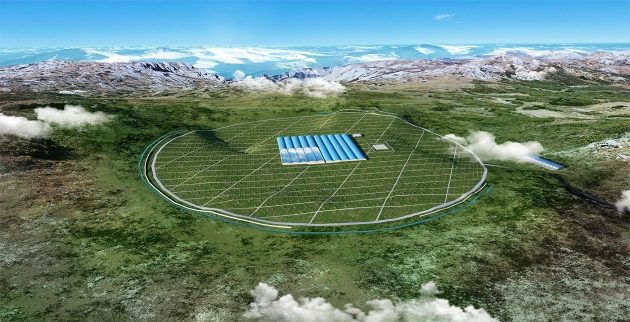
Figure 1: Artist’s impression of the Aquila Booster and LHAASO. (Credit: LHAASO Collaboration)
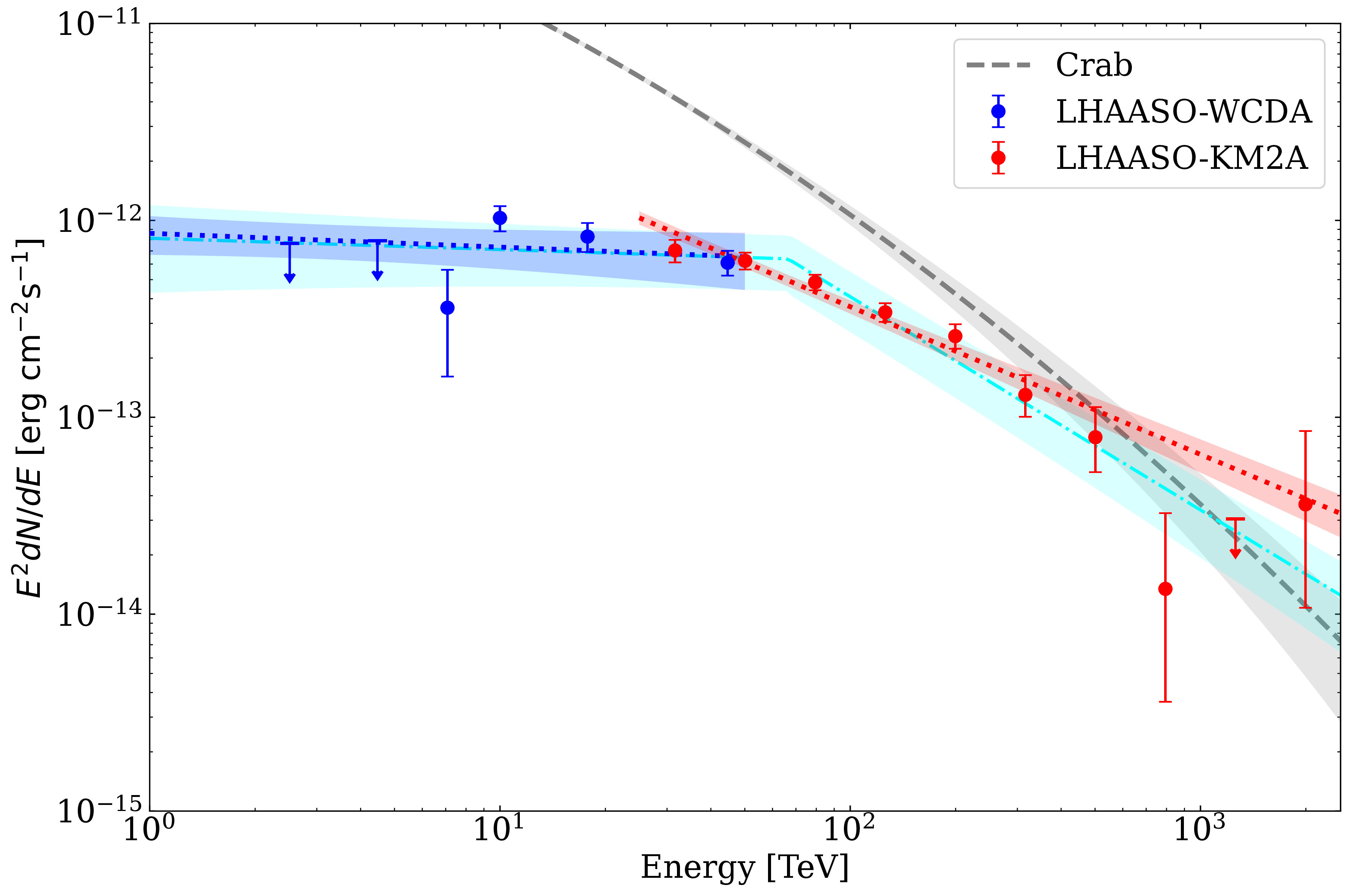 Figure 2: The fluxes of the LHAASO J1849-0001 region and the Crab Nebula are comparable near peta-electronvolt energies. Given that PSR J1849-0001 is more distant from Earth than the Crab Nebula, it can be inferred that its PeV luminosity exceeds that of the Crab Nebula by approximately one order of magnitude. (Credit: LHAASO Collaboration)
Paper Link: https://doi.org/10.1038/s41550-026-02839-0
Related News
China starts building huge cosmic-ray observatory to study the evolution of the universe
03-16,17

04-28,19
China's Large High Altitude Air Shower Observatory (LHAASO) launched its first set of detectors o...