LHAASO's high-precision measurement of the helium spectrum above 0.1 PeV: New Clues to the Origin of High-Energy Cosmic Rays
Recently, the Large High Altitude Air Shower Observatory (LHAASO) achieved a breakthrough in high-precision, element-resolved measurements of cosmic-ray spectra in the "knee" region. The LHAASO Collaboration has observed unexpected variations in the flux of helium nuclei in cosmic rays as a function of energy per nucleus, along with novel features in the evolution of cosmic ray abundance resulting from these variations. The results were published online on March 26, 2026, in Physical Review Letters (Phys. Rev. Lett. 136, 121001 (2026)); the paper was selected as an Editors' Suggestion and featured by APS Physics. The work was led by the Institute of High Energy Physics, Chinese Academy of Sciences, with collaborators from Sapienza University of Rome and other institutions. The corresponding authors, all from the Institute of High Energy Physics, are WANG Liping, MA Lingling, ZHANG Shoushan, and CHEN Suhong.
Cosmic rays are high-energy particles from outer space, spanning an enormous energy range from 109 eV to beyond 1020 eV, while their flux falls rapidly with energy. Around 3 PeV, the flux steepens abruptly, producing a knee-like feature in the spectrum that has been referred to as the "knee" for nearly 70 years. On March 26, 2024, LHAASO released the most precise measurements to date of the all-particle flux and the mean mass as functions of energy (PRL 132, 131002 (2024)), showing that the knee is dominated by hydrogen and helium nuclei. Subsequently, on November 16, 2025, LHAASO reported the hydrogen (i.e., proton) spectrum (Sci. Bull. 70 (2025) 4173–4180). With precision comparable to that of space-borne instruments, they found spectral features that differ markedly from the knee-like structure of the all-particle spectrum, indicating a characteristic PeV high-energy component contributed by peta–electron-volt cosmic accelerators (PeVatrons).
The high-precision helium nuclear energy spectrum released this time shows the existence of similar high-energy component. At approximately 1 PeV, the energy spectrum deviates from the known decreasing trend observed by space-borne detectors, exhibiting the new component characterized by a bulge. A notable sudden decrease in the helium flux is observed near 7 PeV. In conjunction with the measurement of the hydrogen spectrum, these findings confirm the significant conclusion that the dominant composition of cosmic rays in the "knee" region is hydrogen and helium nuclei. The intricate structure of the energy spectrum indicates the coexistence of multiple types of acceleration sources within the Milky Way galaxy.
In addition, LHAASO’s high-precision measurements reveal an intriguing evolution characterized by alternating changes in the relative abundances of cosmic ray species. At low energies, hydrogen accounts for as much as 90% of cosmic rays, but its fraction decreases noticeably with energy. Around 0.02 PeV, helium overtakes protons in abundance, and based on such trends it had been expected that helium would dominate in the PeV band. However, LHAASO finds that protons again surpass helium around 0.7 PeV and remain dominant up to about 5 PeV, after which helium once more becomes the most abundant species. This alternation of relative abundances with energy reflects the presence of multiple, diverse sources within the Galaxy that contribute differently to various species. The detailed mechanisms require further study, particularly through comprehensive multi-wavelength and multi-messenger observations of their source candidate objects.
For the first time, LHAASO has carried out high-precision measurements of both the proton and helium spectra in the knee region, discovering a new PeV high-energy component. These findings may be linked to PeVatrons already detected in the Milky Way by LHAASO—such as microquasars and young massive star clusters—and they provide key new clues to the origin and acceleration mechanisms of Galactic high-energy cosmic rays.
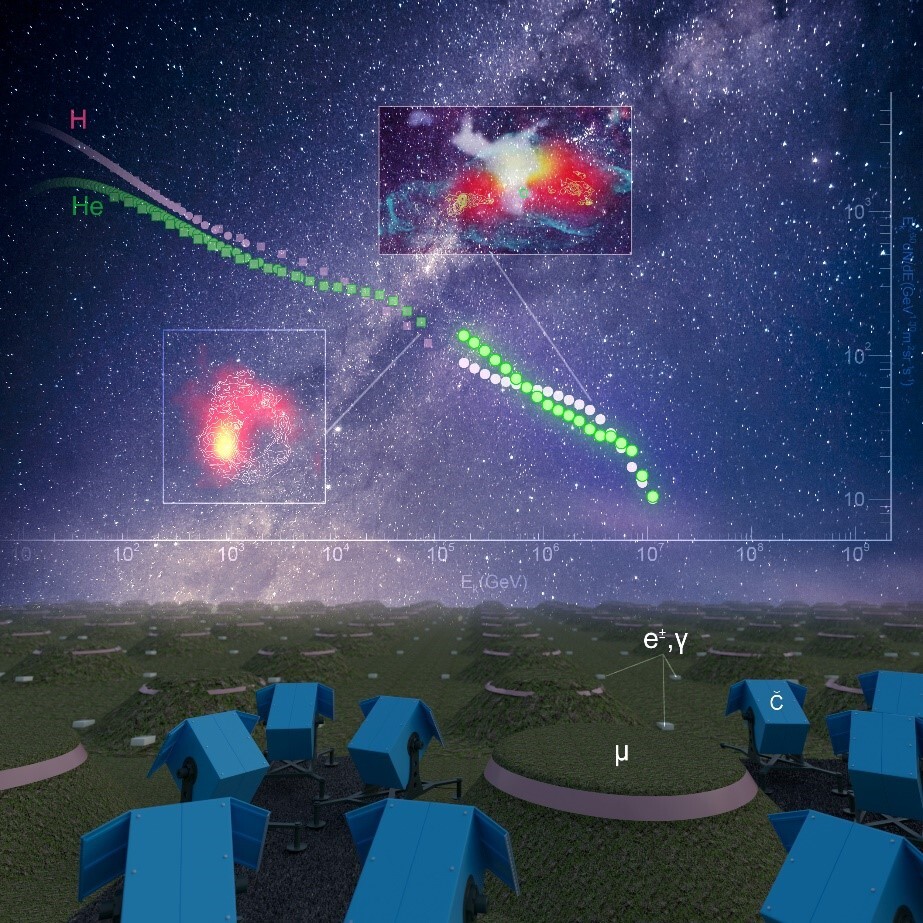
Figure 1: The spectra of hydrogen and helium nuclei across the GeV–PeV energy range have been measured with high precision: the low-energy range by the Alpha Magnetic Spectrometer (AMS) on the International Space Station, the mid-energy range by the “Wukong” satellite (DAMPE), and the high-energy range by LHAASO.