A New Method for Predicting Individualized Onset Time of Alzheimer's Disease
The pathological process of Alzheimer’s disease (AD) begins decades before the onset of clinical dementia symptoms. In recent years, the efficacy of newly approved anti-amyloid-beta (Aβ) therapies has been shown to depend critically on early intervention, making accurate prediction of individual dementia onset time in the pre-symptomatic stage an urgent clinical need. However, existing approaches often overlook the temporal heterogeneity among different biomarkers and typically rely on longitudinal follow-up data, limiting their applicability in real-world clinical settings where only single cross-sectional assessments are available.
To address this challenge, research team led by Prof. ZHANG Tianhao and Prof. SHAN Baoci from the Institute of High Energy Physics of the Chinese Academy of Sciences, proposed a Multimodal Integrated Spatiotemporal Trajectory Estimation method (MIST). By integrating multimodal PET imaging, structural MRI, and clinical diagnostic information, the method constructs a spatiotemporal progression model of AD biomarkers and reveals a sequential evolution pattern in which abnormalities in Aβ PET, tau PET, and structural MRI emerge in order. The study further demonstrates that optimal predictive biomarkers vary across disease stages: Aβ PET is most informative in cognitively normal individuals, while structural MRI plays a dominant role in the mild cognitive impairment stage.
Using only single cross-sectional data, the model achieves an average prediction error of approximately 1.5 years for dementia onset, with an accuracy of 87% for predicting conversion within three years (Figure 1). This approach provides a new pathway for AD risk stratification and personalized disease management.
The findings were published in the European Journal of Nuclear Medicine and Molecular Imaging.
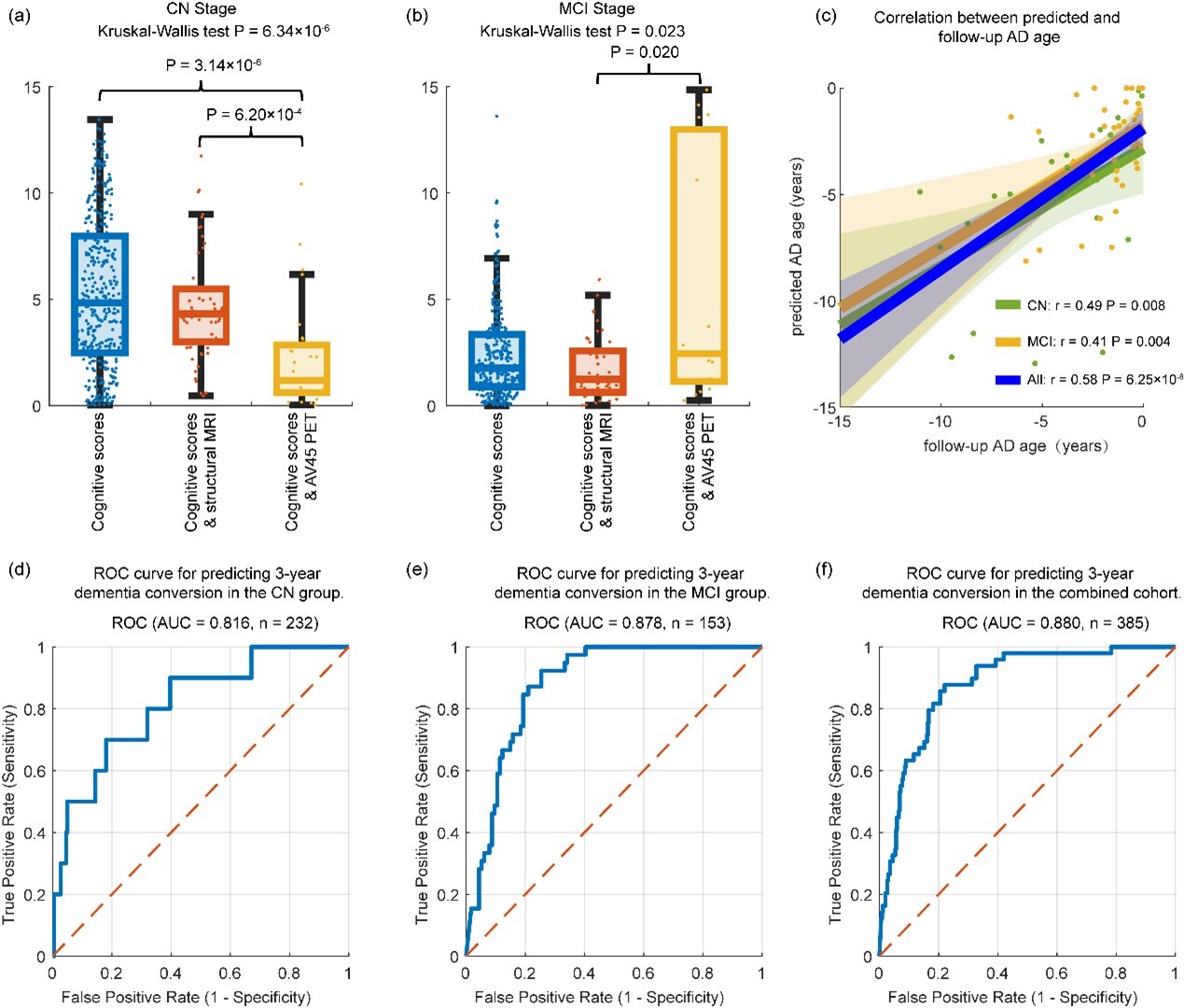
Figure 1. Prediction performance of dementia onset time based on stage-specific optimal biomarkers and discrimination of conversion risk within three years.