Secondary Batteries Research Group Published Perspective Article in Advanced Materials
A research team led by DONG Kang and CHANG Guangcai from the Institute of High Energy Physics (IHEP) of the Chinese Academy of Sciences, in collaboration with SUN Xueliang's team from the Eastern Institute of Technology, Ningbo, recently published a perspective article in the prestigious materials science journal Advanced Materials. The article, titled "Unraveling Working and Degradation Mechanisms of Energy Storage and Conversion Materials at the Nanoscale Using Synchrotron X-Ray Characterizations," highlights the use of synchrotron radiation techniques for studying energy materials.
The High Energy Photon Source (HEPS), a fourth-generation synchrotron light source constructed by IHEP, is currently undergoing trial operation. The article introduces several representative technical methods available at the beamlines constructed during HEPS project. Using recent research as examples, it systematically elaborates on how synchrotron radiation-based techniques, leveraging the high brightness and coherence of third/fourth-generation light sources, can be used to study the morphological structure, crystal structure, electronic structure, and chemical evolution processes within energy materials at the nanoscale. This approach reveals the working and failure mechanisms of key materials in energy storage and conversion technologies such as lithium batteries and fuel cells.
The degradation of energy materials, such as lithium battery cathode and anode materials, often stems from nanoscale "hidden changes" that occur during charge and discharge cycles. These changes include lattice distortion, microcrack initiation, and alterations in the atomic coordination environment of key elements, which are often difficult to detect accurately using traditional characterization methods. To address this challenge, the article highlights three major categories of cutting-edge characterization techniques: (1) High-resolution imaging: Techniques such as transmission X-ray microscopy (TXM) and X-ray fluorescence nanoimaging can clearly visualize the evolution of nickel, cobalt, and manganese element valence states in lithium-ion battery cathode materials at different charge/discharge stages with tens of nanometers resolution. This reveals the three-dimensional distribution of elements and the initiation and propagation of microcracks within the material. (2) Atomic/crystal structure analysis: Techniques such as scanning nano X-ray diffraction microscopy (SnXDM) and Bragg coherent diffraction imaging (BCDI) can precisely measure lattice expansion, contraction, and irreversible "distortion" during electrochemical reactions. The accumulation of these lattice defects is a key factor leading to material performance degradation. (3) Electronic structure probing: Methods such as high-energy-resolution fluorescence-detected X-ray absorption spectroscopy (HERFD-XAS) and resonant inelastic X-ray scattering (RIXS) can probe the electronic states of key elements (such as oxygen, nickel, and manganese) and the irreversible evolution processes of these elements within the lattice.
Recognizing that a single technique often provides limited information, the research team proposes a multi-modal and multi-scale research strategy. This approach integrates the advantages of different techniques to correlate nanoscale information with the macroscopic electrochemical performance of materials, establishing intrinsic relationships across scales (from atoms to devices) and across multiple types of information. The article concludes by discussing current challenges and potential opportunities, including reducing X-ray radiation damage to samples, designing adapted in-situ experimental setups, and utilizing artificial intelligence to process large datasets, automatically identify material defects, and predict material properties and performance.
WANG Zhiqiang, a postdoctoral fellow at IHEP, is the first author of this article. DONG Kang, CHANG Guangcai, and SUN Xueliang are the co-corresponding authors. This work was supported by funding from the National Key Research and Development Program of China, the National Natural Science Foundation of China, the China Postdoctoral Science Foundation, and the Science and Technology Innovation Program of IHEP.
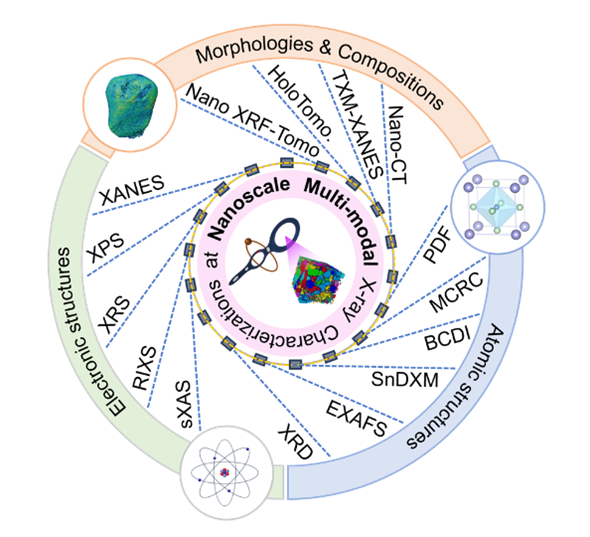
Figure: Summary of Synchrotron-Based Nanoscale Multi-Modal Characterization Techniques
Article link: https://advanced.onlinelibrary.wiley.com/doi/full/10.1002/adma.72655