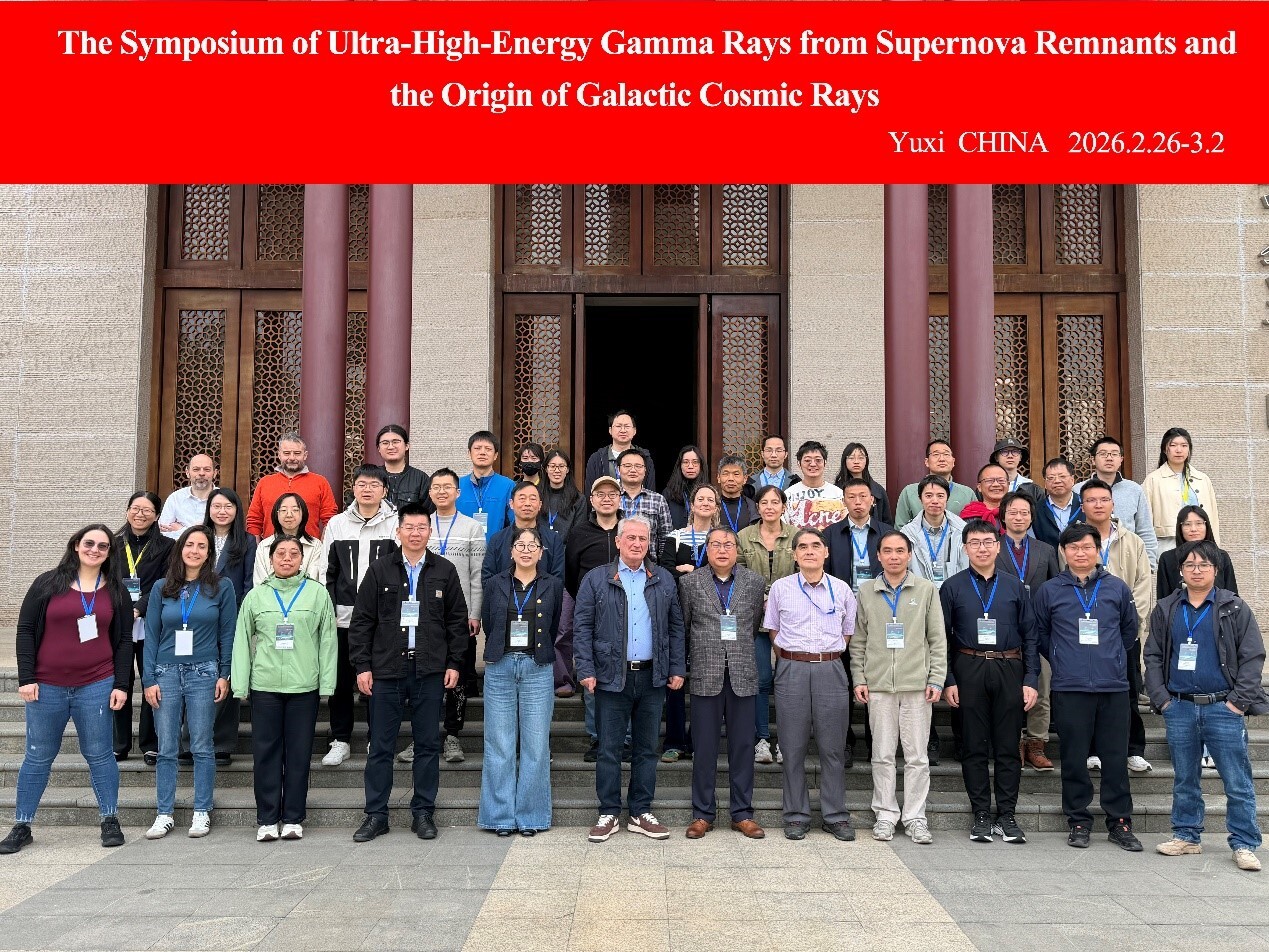
Symposium on Ultra-High-Energy Gamma Rays from Supernova Remnants and the Origin of Galactic Cosmic Rays Held
The Symposium on Ultra-High-Energy Gamma Rays from Supernova Remnants and the Origin of Galactic Cosmic Rays (SNR Symposium) was successfully convened in Chengjiang, Yuxi, Yunnan Province, from February 26 to March 2.
While the hypothesis that supernova remnants (SNRs) serve as the primary sources of Galactic cosmic rays is supported by theories and the diffusive shock acceleration mechanism, critical controversies persist. The Large High Altitude Air Shower Observatory (LHAASO) has not detected ultra-high-energy (E > 100 TeV) gamma rays from young SNRs, casting doubt on their capability to act as "PeVatrons" (PeV-scale cosmic-ray sources/high-energy particle accelerators). The cause of the steep spectra in the TeV energy range from young SNRs remains unexplained, and observational evidence of ultra-high-energy gamma rays surrounding middle-aged SNRs urgently demands in-depth analysis. This symposium aimed to gather experts in cosmic-ray physics and SNR research to explore the implications of ultra-high-energy gamma-ray observations for both young and middle-aged SNRs.
As an international conference, the symposium attracted 59 participants from 20 research institutions and universities across China, Germany, Italy, Poland and Japan, with 34 oral presentations delivered. The discussions centered on key topics including gamma-ray observations of SNRs, theories of cosmic-ray acceleration to ultra-high-energy regimes, multi-wavelength observations of SNRs in coincidence with ultra-high-energy and very-high-energy gamma rays, dense ambient gas impacted by cosmic rays and SNRs, as well as shock physics and magnetic fields. A dedicated 40-minute group discussion session was held following daily presentations, and an extensive 150-minute summary and open discussion was organized on March 1.
Through this intensive interactive format, participating experts and scholars engaged in in-depth and open exchanges in a relaxed yet rigorous academic atmosphere. The symposium clarified ongoing debates over the nature of "PeVatrons" and the maximum acceleration energy of SNRs, and reached important consensus on advancing collaborative research between LHAASO and other domestic experiments.
On March 2, the conference organized a technical visit to the Fuxian Lake Solar Observatory of Yunnan Observatories, Chinese Academy of Sciences, where participants gained insights into the structure, operation and observational activities of solar telescopes.
The symposium was co-hosted by the Institute of High Energy Physics of Chinese Academy of Sciences and Yunnan University, and co-organized by Yunnan Observatories of Chinese Academy of Sciences, Yuxi Normal University, and Tianfu Cosmic Ray Research Center, and supported by the China Center for Advanced Science and Technology.