
The BESIII collaboration has reported "First Experimental Constraint on the Scalar Current in the D⁰⁽⁺⁾ → K̅ l⁺ νₗ Transition" and "Precise measurements of D⁰ → K⁻ l⁺ νₗ and D⁺ → K̅⁰ l⁺ νₗ decays". These results have been published in Physical Review Letters [Phys. Rev. Lett. 137, 091803 (2026)], accompanied by a detailed companion paper in Physical Review D [Phys. Rev. D. 114, 033008 (2026)] on 27 Aug 2026.
Precise measurements of semileptonic D decays are important for our understanding of the weak and strong interactions in the charm sector. Their decay dynamics are sensitive to both the magnitude of the Cabibbo-Kobayashi-Maskawa matrix element |Vcs(d)|, and corresponding hadronic transition form factors f(q²). Among various decay modes, the dominant one D⁰⁽⁺⁾ → K̅ l⁺ νₗ is of special interest. Through precise experimental measurements of its decay dynamic, the product f(0)·|Vcs|, could be extracted, which enables a stringent test of the different theoretical predictions on f(0), as well as the unitarity of the CKM matrix. Additionally, semileptonic D decays provide an unique platform to search for new physics contribution. In recent years, some hints of violations of lepton flavor universality have been reported in b → c l⁺ νₗ and b → s l⁺ l⁻ transitions, which could be caused by potential scalar current particle beyond the Standard Model. Inspired by the results in the beauty sector, searches for scalar current in charm sector, especially in D⁰⁽⁺⁾ → K̅ l⁺ νₗ via c → s l⁺ νₗ, is highly desired.
In this work, using 20.3 fb⁻¹ of e⁺ e⁻ collision data collected at 3.773 GeV with the BESIII detector, we present a precise determination of branching fractions, as well as partial decay widths and forward-backward asymmetries in different momentum transfer q² regions of D⁰⁽⁺⁾ → K̅ l⁺ νₗ. Based on a simultaneous fit to these observables, we present the first experimental constraint on the scalar current in c → s l⁺ νₗ transition. For the muonic decay modes, a mild hint of excess is seen with a significance 2.3σ, as shown in Fig. 1. The corresponding complex Wilson Coefficient is determined to be Re(Cμs) = (0.017 ± 0.008 ± 0.006) and Im(Cμs) = ±(0.077 ± 0.011 ± 0.009). From the fit, the product f(0)·|Vcs| is extracted to be 0.7183 ± 0.0007 ± 0.0014 with the world best precision 0.23%. Taking the world averaged value of |Vcs|, the hadronic form factor is calculated to be f(0) = 0.7383 ± 0.0007 ± 0.0014, which is the most stringent test on different theoretical calculations. Taking the Lattice QCD predicted f(0), the |Vcs| is determined to be 0.9369 ± 0.0009 ± 0.0018 ± 0.0040, which is consistent with the CKM unitarity prediction, and contributes 58% of the averaged value of |Vcs| as shown in Fig. 2.
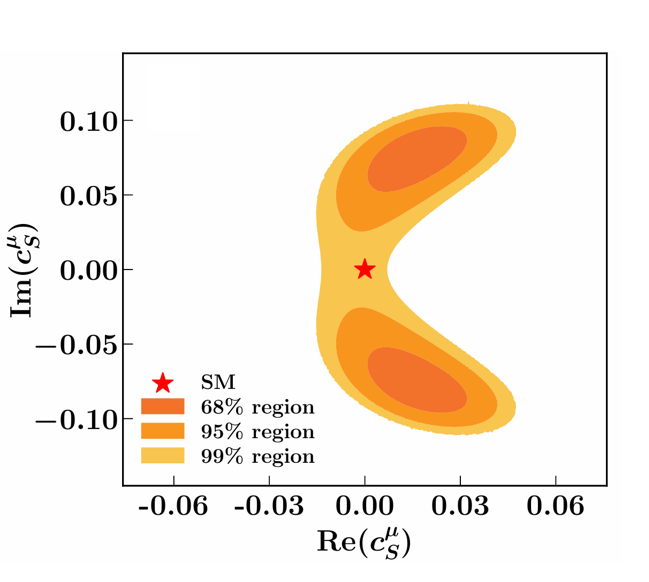
Fig. 1. The parameters of the scalar current in the muon channel at BESIII.
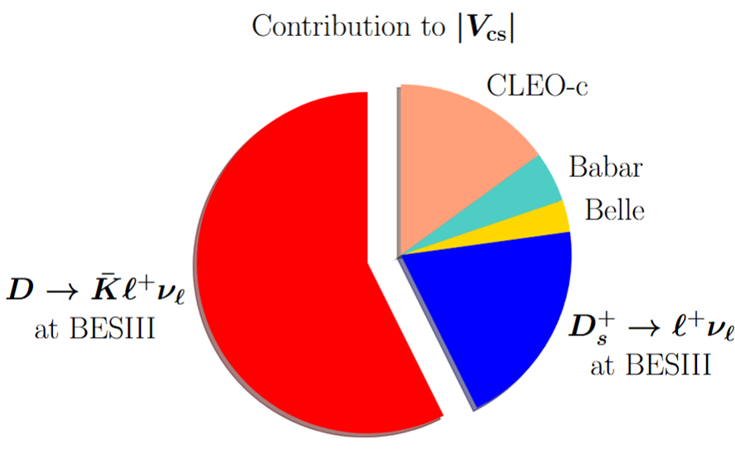
Fig. 2. Contribution to |Vcs| average.