Antinucleon–nucleon annihilation provides an important probe of the strong interaction in the nonperturbative regime. Antineutrons offer unique advantages because they carry no electric charge and are therefore free from Coulomb effects. However, experimental studies of antineutron interactions have long been limited by the difficulty of producing and controlling antineutron beams. Previous measurements mainly covered relatively low antineutron momenta, and experimental data above 800 MeV/c were previously unavailable.
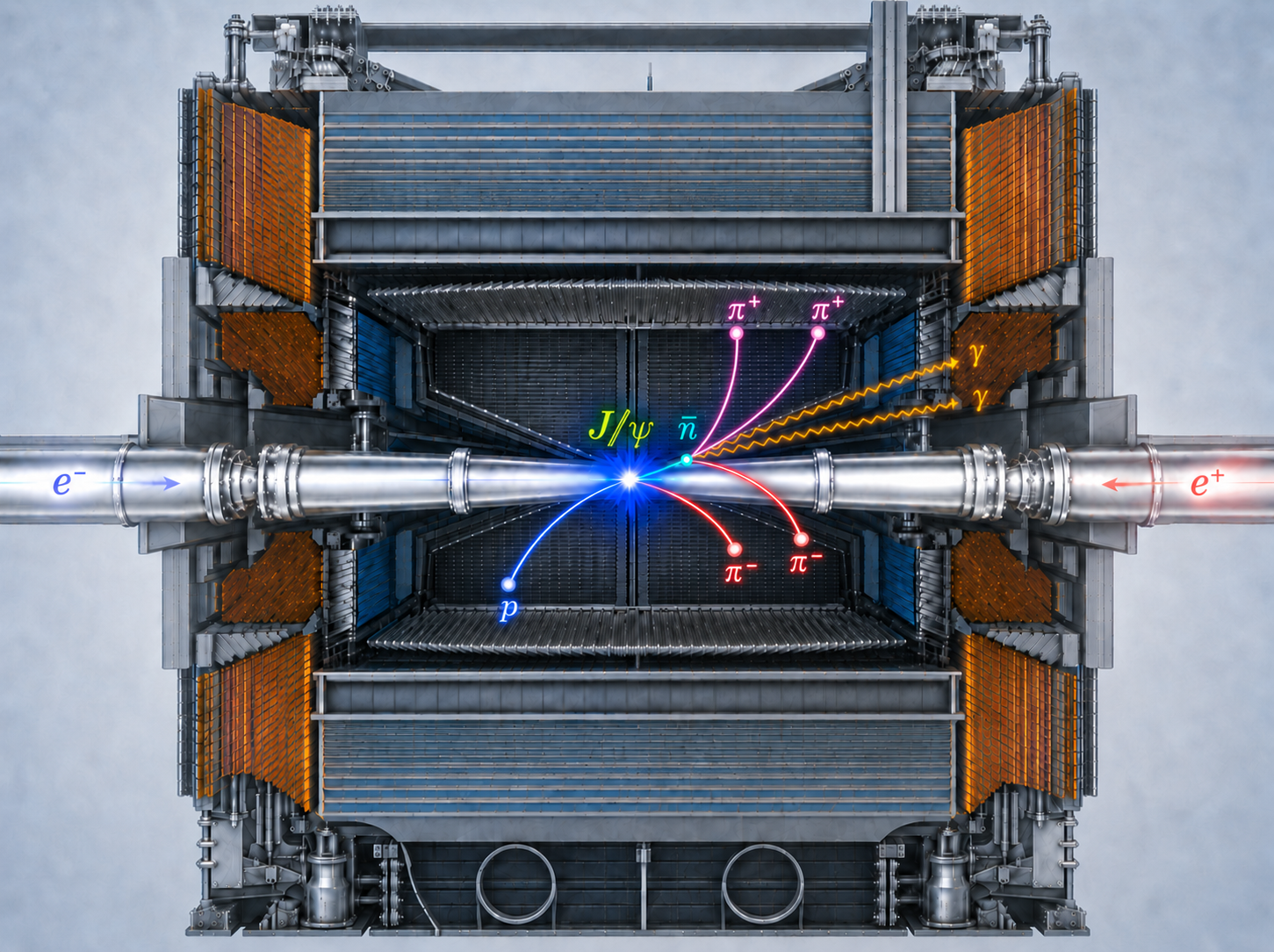
Using a sample of approximately 10 billion J/ψ events collected with the BESIII detector, the research team utilized antineutrons produced in the decay J/ψ → p π⁻ n̄. By reconstructing the proton and π⁻ from the J/ψ decay, the momentum and direction of the antineutron can be accurately determined. The hydrogen nuclei in the cooling oil of the BESIII beam pipe provide nearly stationary proton targets, allowing antineutron–proton interactions to be studied over a continuous antineutron momentum range.
Figure 1: Schematic diagram of antineutrons produced in J/ψ → p π⁻ n̄ decays and their subsequent interactions with protons in the BESIII beam pipe.
The cross sections of the three reactions n̄ p → 2 π⁺ π⁻, n̄ p → 2 π⁺ π⁻ π⁰, and n̄ p → 2 π⁺ π⁻ 2 π⁰ were measured for the first time. The measurements cover antineutron momenta from 200 to 1174 MeV/c and were performed in five momentum intervals. In particular, the results provide the first experimental data for antineutron momenta above 800 MeV/c, extending antineutron–proton annihilation measurements into a previously unexplored momentum region.
Further studies of the invariant mass spectra of the final-state pions reveal clear contributions from the ρ and ω intermediate states, indicating an important role of vector mesons in antineutron–proton annihilation. The results also indicate enhanced contributions from higher multiplicity multi-pion final states at higher energies. These results provide new experimental input for understanding nucleon–antinucleon annihilation dynamics and for the development of antinucleon–nucleon interaction models.
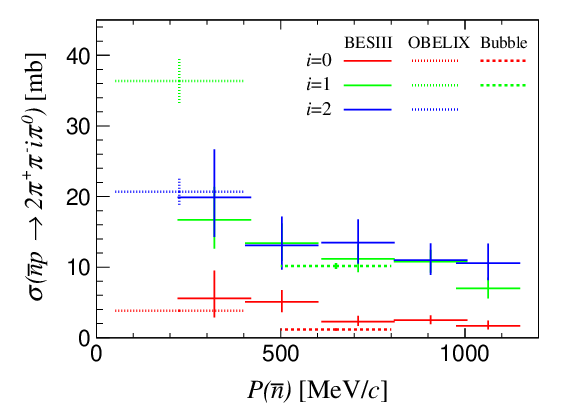
Figure 2: Measured cross sections of the three antineutron–proton annihilation processes and comparison with previous experimental results.
This study demonstrates a new approach to investigating antineutron–nucleon interactions at an electron–positron collider by combining antineutrons from J/ψ decays with target nucleons in detector material. Future high-luminosity facilities, such as the proposed Super Tau-Charm Facility, are expected to provide much larger J/ψ samples and enable more precise studies of antineutron and other long-lived antibaryon interactions with nucleons.