The BESIII collaboration has reported “Observation of the Singly Cabibbo Suppressed Decay D⁰→b₁(1235)⁻e⁺νₑ and evidence for D⁺→b₁(1235)⁰e⁺νₑ”. The results have been published in Physical Review Letters on January 13, 2026. [Phys. Rev. Lett. 136, 021801 (2026)].
Experimental investigations of light hadron spectroscopy in semileptonic D decays can be used to shed light on the role of non-perturbative strong interactions in weak decays, thereby aiding in uncovering the internal structure of the hadrons involved.
To date, studies of Cabibbo-suppressed semileptonic D decays are not as advanced as their Cabibbo-favored counterparts, which have been extensively studied both theoretically and experimentally. In general, these decays, which are mediated by the quark level process c→de⁺νₑ, are expected to be dominated by the ground state pseudoscalar and vector mesons. Due to limited phase space, heavier mesons, such as P-wave states or the first radial excitations of the dū and dd̄ mesons, are less likely to be produced. Among the heavier mesons, the most promising to be produced is the P-wave b₁(1235) meson, which is accessible via D→b₁(1235)e⁺νₑ.
The b₁(1235) mesons produced in semileptonic D decays offer an ideal opportunity to validate different theoretical models for the nature of b₁(1235), thereby gaining insight into its internal structure. The verification of theoretical calculations of semileptonic D decays into the b₁(1235) help to constrain the theoretical calculations in the decays of the τ, B, D, and charmonium states with b₁(1235) involved in the final states.
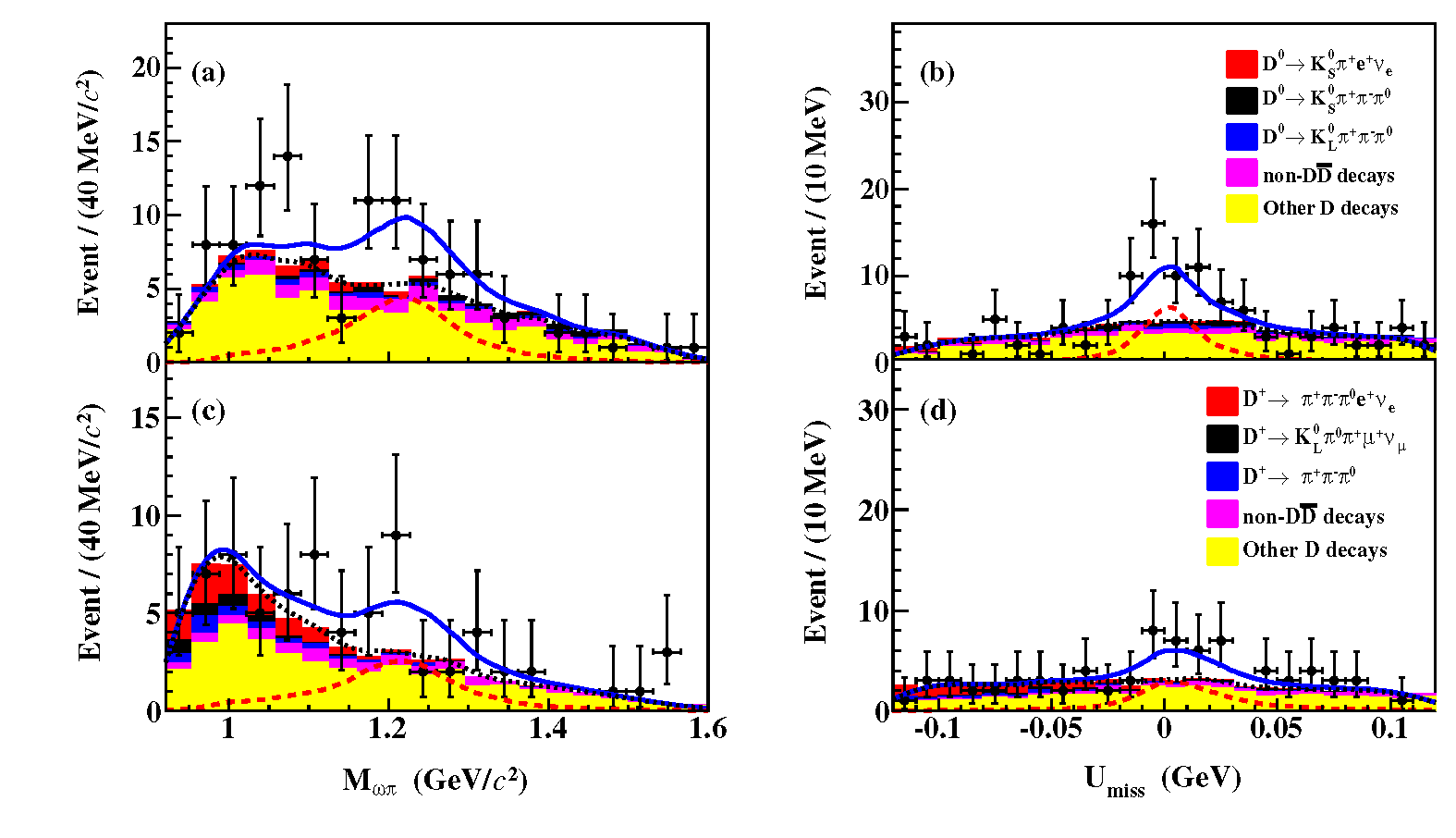
Fig. 1: The fits to the Mωπ and Umiss distributions for the decays of D⁰(⁺)→b₁(1235)⁻(⁰)e⁺νₑ
The first observation of D⁰→b₁(1235)⁻e⁺νₑ is reported with a significance of 5.2σ after considering systematic uncertainty, while evidence for D⁺→b₁(1235)⁰e⁺νₑ is obtained with a significance of 3.1σ. The product branching fractions are determined to be B(D⁰→b₁(1235)⁻e⁺νₑ) × B(b₁(1235)⁻→ωπ⁻) = (0.72±0.18-0.08+0.06)×10⁻⁴ and B(D⁺→b₁(1235)⁰e⁺νₑ) × B(b₁(1235)⁰→ωπ⁰) = (1.16±0.44±0.16)×10⁻⁴. Assuming B(b₁(1235)→ωπ)=1, these results are comparable with the theoretical predictions reported, thereby implying that the ωπ final state is currently the dominant decay mode of b₁(1235), which supports b₁(1235) is the traditional qq̄ state and helps to rule out some theoretical models.
Reference: Phys. Rev. Lett. 136, 021801 (2026)