
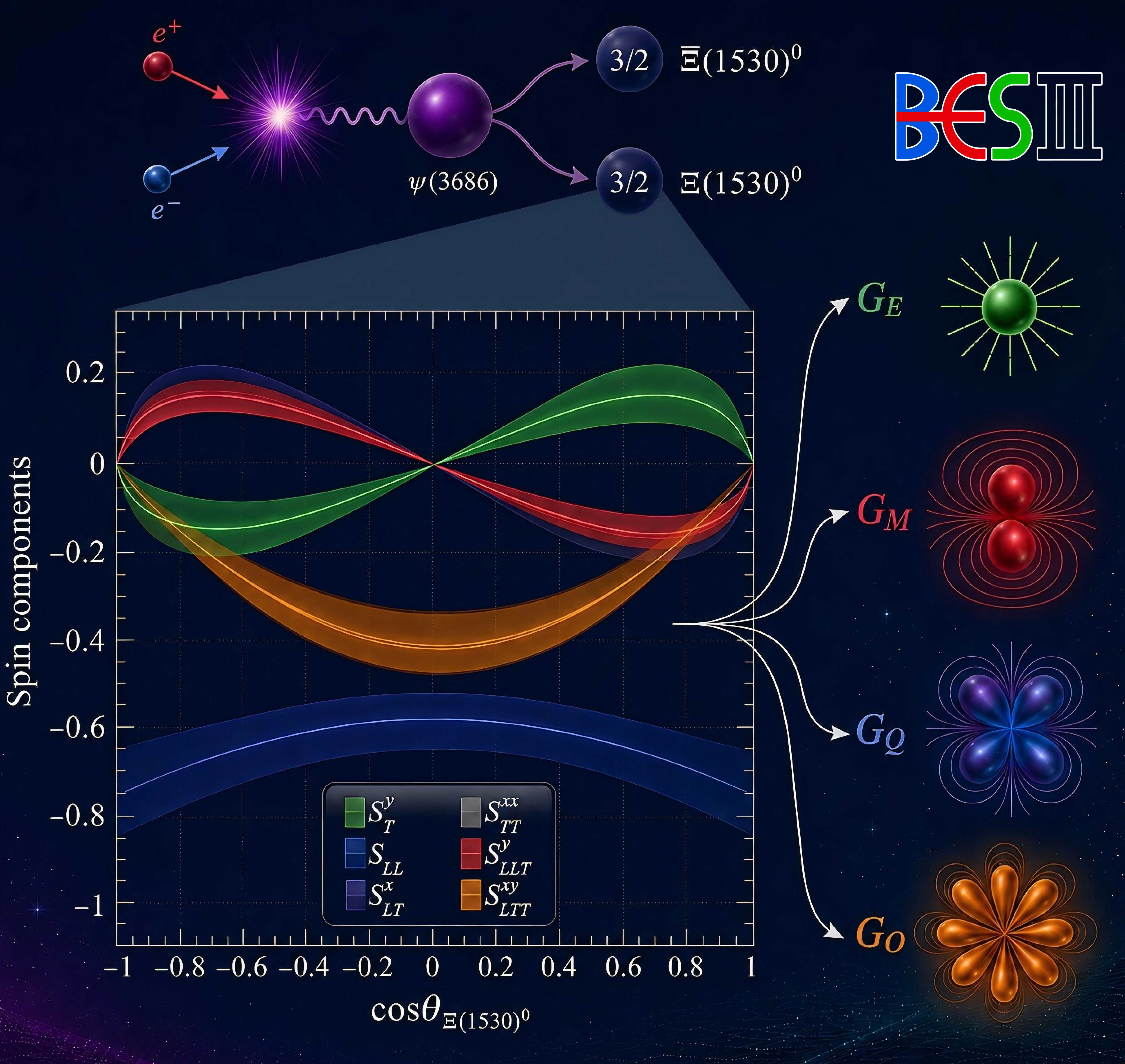
Figure 1: Illustration of the reaction process, the polarization components of the Ξ(1530)⁰, and its electric and magnetic moments structure.
Quantum Chromodynamics (QCD) describes the strong interaction among quarks and gluons. Although it has been successfully tested at high energies, its behavior in the low-energy, nonperturbative regime remains a central question in particle physics. Baryons, the simplest three-quark systems, provide an important window into this regime. The electromagnetic form factors of baryons reveal how charge and magnetization are distributed inside these particles. Unlike spin-1/2 baryons, which are described by two form factors, spin-3/2 baryons require four independent form factors corresponding to the electric charge (GE), magnetic dipole (GM), electric quadrupole (GQ), and magnetic octupole (GO) moments. Among them, the higher-order multipole moments offer a more detailed picture of the internal structure of baryons. However, their experimental determination has long been a major challenge. Recent advances in the theoretical description of angular distributions in the helicity framework have opened a new avenue for extracting baryon form factors through polarization measurements.
Using a data sample of 2.7×10⁹ ψ(3686) events collected with the BESIII detector at the BEPCII collider, the BESIII Collaboration studied the process e⁺e⁻→ψ(3686)→Ξ(1530)⁰Ξ̄(1530)⁰ and its subsequent cascade decays. By performing a joint angular distribution analysis, the collaboration achieved the first observation and measurement of the polarization and electric and magnetic moments of spin-3/2 baryons. The angular distribution parameter is measured to be αψ=0.02±0.06±0.06, the moduli of form factors are determined to be |GE|=(0.35±0.06±0.04)×10⁻², |GM|=(0.56±0.06±0.03)×10⁻², |GQ|=(1.29±0.07±0.05)×10⁻², and |GO|=(0.39±0.01±0.01)×10⁻². The significance of the total polarization of the Ξ(1530)⁰ is found to exceed 20σ. The polarization is observed not only in the vector component but also in the quadrupole and octupole components.
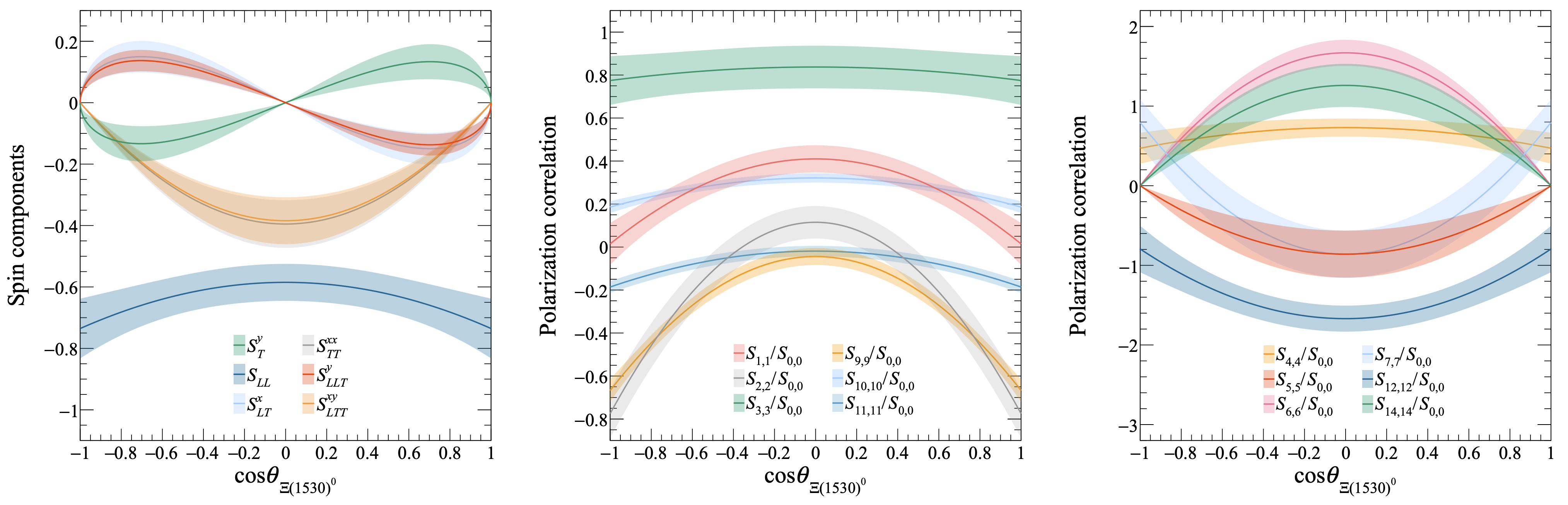
Figure 2: The cosθΞ(1530)⁰ dependence of the non-zero independent polarization components and the polarization correlation terms.
The results further show that the Ξ(1530)⁰ has significant nonzero electric quadrupole and magnetic octupole moments, indicating that its internal charge and magnetization distributions deviate from spherical symmetry and exhibit a more complex three-dimensional structure. This analysis fills a gap in the experimental information on higher-order baryon multipole moments, offering important insights into baryon structure and providing a valuable benchmark for lattice QCD and quark model calculations.
Link to the paper: https://journals.aps.org/prl/abstract/10.1103/mbrf-3ly5