The BESIII Collaboration has reported a new precise measurement of the chromoelectric dipole moment (CEDM) of the charm quark. The result has been published in Physical Review Letters [Phys. Rev. Lett. 136, 231903 (2026)].
The existence of a non-zero permanent electric dipole moment (EDM) would violate time-reversal symmetry and, by the CPT theorem, CP symmetry. Investigations of EDMs enrich our understanding of natural symmetries and open up new avenues for research beyond the Standard Model (SM). While all CP violation measurements to date are consistent with the SM, they are insufficient to fully account for the observed matter-antimatter asymmetry in the universe, motivating the search for new sources of CP violation.
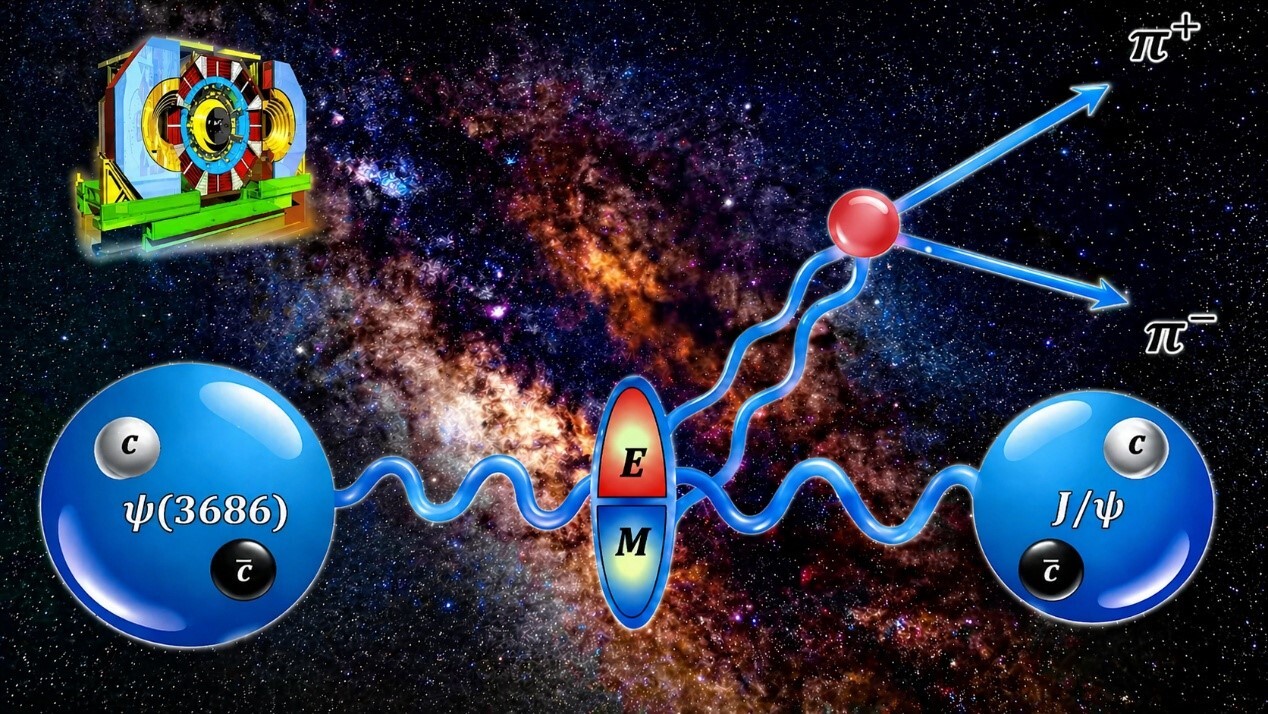
Figure 1 Diagram of ψ(3686) → π⁺π⁻ J/ψ decay process.
Using a dataset of (2712.4 ± 14.3) × 10⁶ ψ(3686) events collected with the BESIII detector at the BEPCII collider, the collaboration investigated the hadronic transition ψ(3686) → π⁺π⁻ J/ψ with subsequent leptonic decays J/ψ → e⁺e⁻ and J/ψ → μ⁺μ⁻. The CP asymmetry observable, constructed from the momenta of the final-state particles, is determined to be A_CP = (0.6 ± 1.8 ± 0.1) × 10⁻⁴, which is consistent with CP conservation.
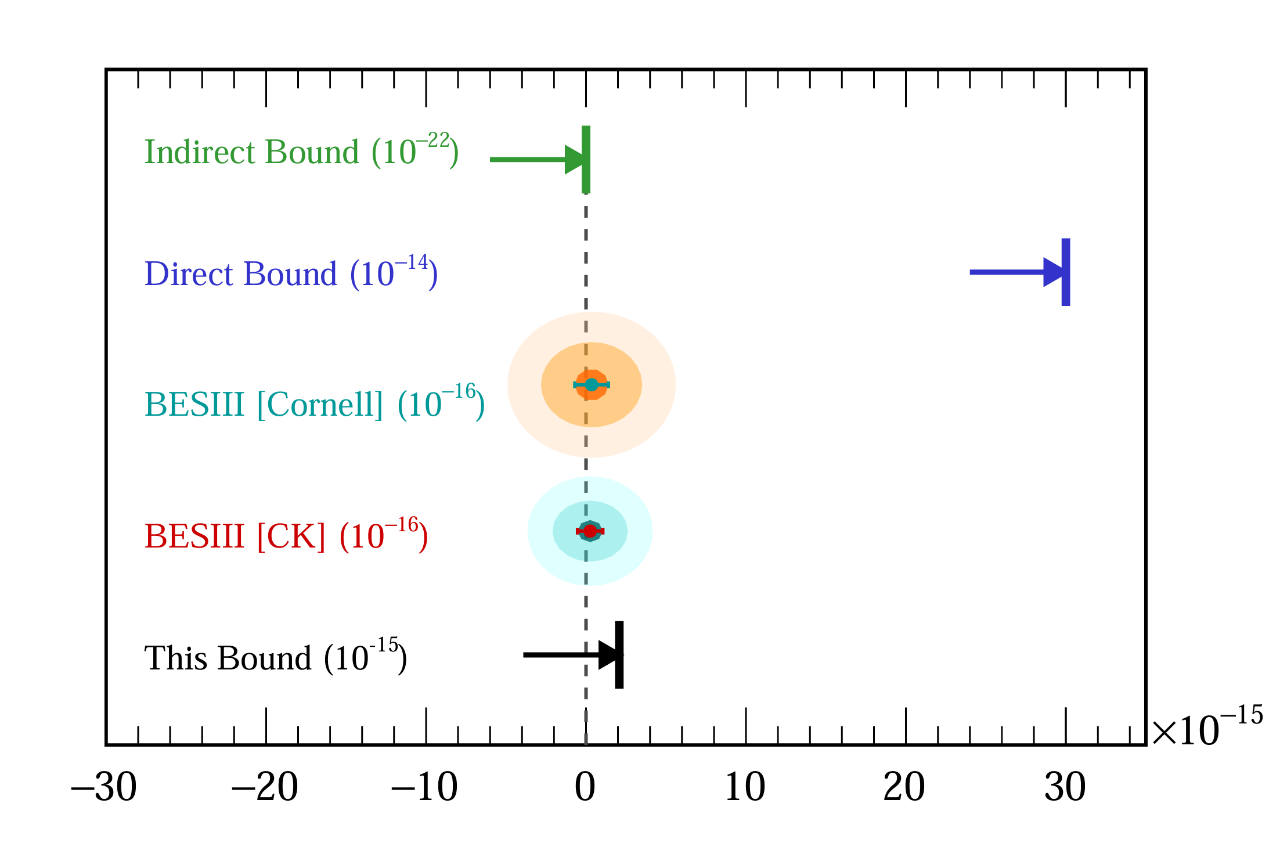
Within the framework of QCD multipole expansion, the CEDM d'_c is proportional to the CP-odd observable A_CP. Based on the measured asymmetry, the collaboration extracted the charm CEDM as: d'_c = (2.6 ± 7.8 ± 0.4 ± 0.6) × 10⁻¹⁶ e·cm under the Chen–Kuang model, and d'_c = (3.5 ± 10.5 ± 0.6 ± 0.5) × 10⁻¹⁶ e·cm under the Cornell potential model.
Figure 2 The measured charm CEDMs and (phenomenological) upper limits.
The uncertainties are statistical, systematic, and theoretical, respectively. These results correspond to an upper limit of |d'_c| < 2.1 × 10⁻¹⁵ e·cm at the 90% confidence level. This represents an order of magnitude improvement in sensitivity compared to the previous direct bound using the same decay process. The improved constraints on the charm CEDM provide valuable insight into possible CP-violating interactions beyond the SM within the QCD framework, and the methodology demonstrated here can be extended to investigate other heavy quarkonium systems, such as the beauty sector.