The BESIII collaboration recently reported the world's most precise measurement of the hyperfine mass splitting of the strange charm mesons, based on a sample of over three million Ds*±Ds∓ pairs produced by e+e- collisions at a center-of-mass energy of 4.178 GeV with an integrated luminosity of 3.19 fb-1, and utilizing the decay chain of Ds*+→Ds+(→K+K-π+)π0. This is a sevenfold precision improvement over the current world average on the Ds*+-Ds+ mass difference. The results have been published recently in Science Bulletin on June 15, 2026 [Sci. Bull. 71 (2026) 2675].
The strong interaction is the strongest fundamental force that binds hadrons, including protons and neutrons, as well as atomic nuclei, acting as the "glue" that holds together all the matter around us. Quantum Chromodynamics (QCD) is the theory describing the strong interaction. However, as in QCD the coupling αs becomes quite large at low energies, significant difficulties arise in explaining non-perturbative QCD phenomena such as generation of hadron masses. Theorists have developed various tools, such as chiral perturbation theory (χPT) and lattice QCD (LQCD), to study the strong interaction in the low-energy regime. Precise measurements of hadron masses can rigorously test these tools and provide important experimental inputs. The mass of the excited-state charmed-strange meson Ds*+ is also of great importance for understanding the c→s vector form factor in semi-leptonic decays of charm mesons, and the nature of exotic states such as Zcs(3985), which lies just above the Ds*+D- production threshold. The Ds*+ mass measurement has not been updated for over 30 years and has the poorest precision among all conventional heavy-flavor mesons (Qqbar). The BESIII experiment is especially advantageous here due to relatively low background level with near-threshold charm production, and superb detector performance in measuring charge tracks and neutral hadrons such as π0.
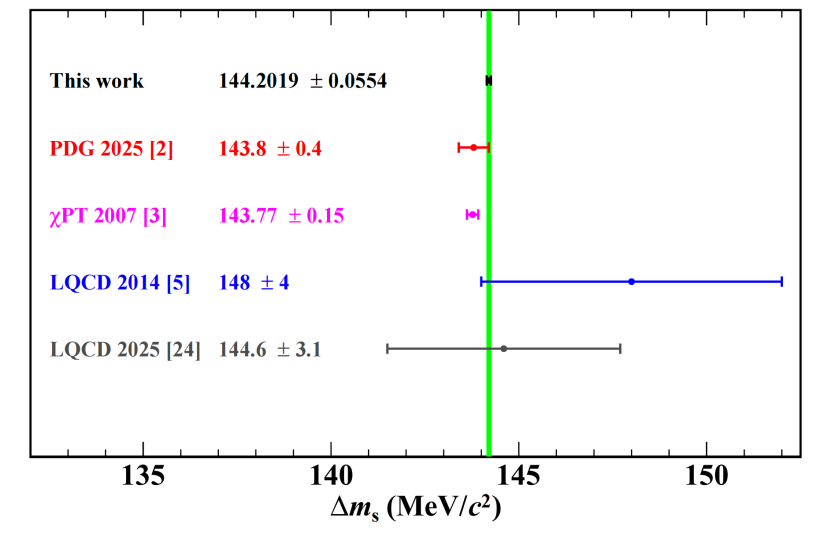
In this work, based on the integrated luminosity of 3.19 fb-1 obtained from the positive and negative electron-positron collision data at the center-of-mass energy of 4.178 GeV in the BESIII experiment, 1411±77 signals of Ds*+→Ds+(→K+K-π+)π0 is reconstructed, and the mass splitting of Ds*+-Ds+ is precisely measured (see Fig. 1). A novel data-driven method is introduced, using the existing high-precision measurement of the Ds*+-Ds+ mass splitting as input, and high-statistics Ds*+→Ds+(→K+K-π+)π0 data samples to calibrate the reconstructed π0 momentum. The systematic uncertainties related to π0 are thus well controlled. The measured mass difference of Ds*+-Ds+ is Δms=144,201.9±44.2(stat)±29.9(syst)±15.0(input), which is seven times more precise than the current world average. This measurement result can be used to strictly test LQCD calculations and theoretical models based on χPT (see Fig. 2). The momentum calibration method employed in this research can be applied to any measurement involving soft π0 reconstruction, e.g., measuring the masses of Ds0*(2317), Ds1(2460) and Ξ0.
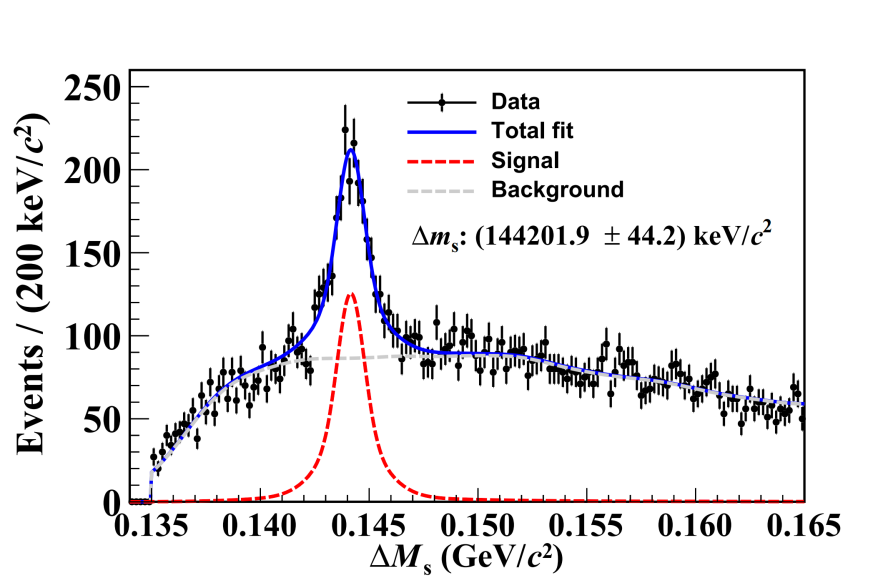
Fig. 1: The fit to the distribution of the reconstructed mass difference ΔMs≡M(Ds+π0)-M(Ds+), from the BESIII data sample of the decay chain Ds*+→Ds+(→K+K-π+)π0.
Fig. 2: Comparison of the Δms result from this work with the world average value and corresponding theoretical predictions.
Further reading: