Recently, the BESIII collaboration has achieved a significant breakthrough in the study of antihyperon–nucleon interactions by observing, for the first time, the annihilation processes of an anti-Lambda hyperon (Λ) with a proton into multi-meson final states. The results of this study have been published in Physical Review Letters (Phys. Rev. Lett. 136, 171904 (2026)).
Fig. 1: Schematic diagram of the Λp annihilation process producing multi-meson final states.
Understanding the strong interaction in systems involving strange quarks remains one of the key challenges in modern hadron physics. Antihyperon–nucleon interactions, in particular, are poorly constrained experimentally due to the lack of intense antihyperon beams. The BESIII experiment provides a unique solution by utilizing anti-Lambda hyperons produced in J/ψ→ΛΛ decays, which subsequently annihilate with protons in the detector material, enabling direct access to these rare processes.
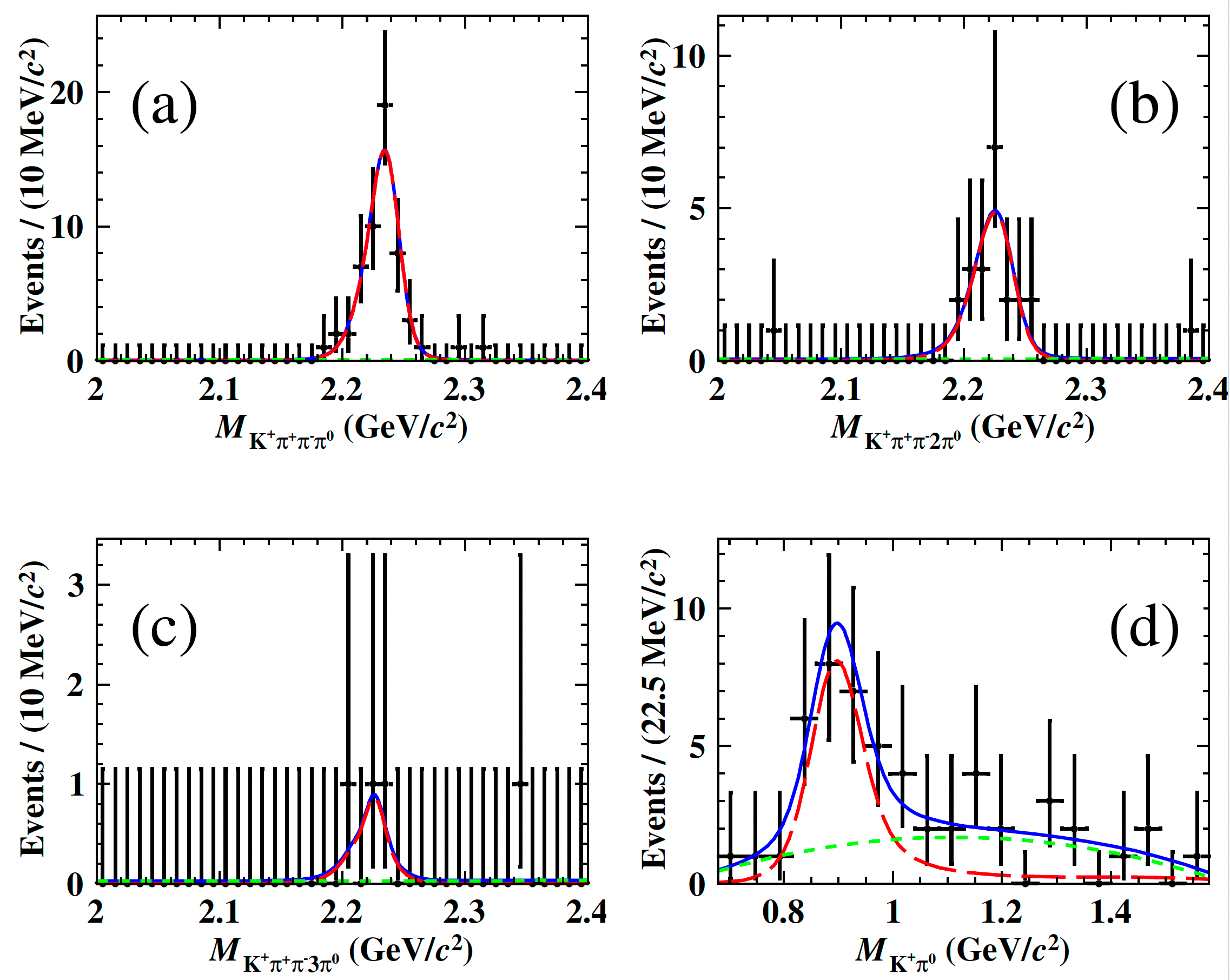
Based on a data sample of approximately 10 billion J/ψ events collected with the BESIII detector, the research team performed a detailed analysis of Λp annihilation channels. The processes Λp →K⁺π⁺π⁻π⁰ and Λp →K⁺π⁺π⁻2π⁰ were observed for the first time, and their corresponding cross sections were measured to be about 8.5 mb and 7.9 mb, respectively. In addition, an upper limit was set for the Λp →K⁺π⁺π⁻3π⁰ channel.
Further investigation of the invariant mass spectra revealed evidence for the intermediate K*(892)⁺ resonance in the K⁺π system. The cross section for the process Λp →K*(892)⁺π⁺π⁻ was measured to be approximately 12.5 mb. These observations provide important insights into the role of intermediate resonances in multi-meson production dynamics.
Fig. 2: Invariant mass distributions of multi-meson final states and comparison with fit results.
These measurements offer valuable constraints on models describing the imaginary part of the baryon–antibaryon interaction potential and provide new input for studies based on SU(3) flavor symmetry, chiral effective field theory, and lattice QCD.
This work represents the first direct experimental study of Λp annihilation into multi-meson final states, opening a new avenue for exploring the strong interaction in the strangeness sector. The results are also relevant for understanding strange antibaryon dynamics in heavy-ion collisions and the properties of dense baryonic matter, such as those found in neutron stars.
Future studies at BESIII and next-generation facilities, such as the proposed Super Tau-Charm Facility, are expected to further improve the precision of such measurements and deepen our understanding of antihyperon–nucleon interactions.