CSES-01 Traces the "BOAT" to Earlier Times: a ~2 MeV Spectral Bump and a ~40 MeV Emission Line
A China–Italy team led by the Institute of High Energy Physics (IHEP) of the Chinese Academy of Sciences has reconstructed the time-resolved spectrum of GRB 221009A—the brightest gamma-ray burst ever observed—from 2 to 255 MeV. Using unsaturated observations by HEPP-H (developed by IHEP) aboard CSES-01 (Zhangheng-1), the team identified a ~2 MeV spectral bump during the main emission peak and traced a narrow ~40 MeV emission line to earlier times. The study has been accepted for publication in The Astrophysical Journal Letters on November 12.
GRB 221009A, about 2.4 billion light-years away, reached Earth on 9 October 2022. Its extreme brightness saturated many conventional gamma-ray detectors during the brightest phase. HEPP-H, originally designed to monitor energetic charged particles, detects gamma rays indirectly through secondary electrons. Its low direct detection efficiency became an advantage, preserving unsaturated data. A dynamic Monte Carlo correction, cross-calibrated with GECAM-C and Fermi observations, recovered the intrinsic spectrum and filled the gap at the burst’s brightest phase.
The ~2 MeV bump appears in all six time intervals analyzed and requires an additional component beyond the standard Band function. If interpreted as thermal emission, it accounts for about 6% of the gamma-ray energy in that period—suggesting a subdominant hot fireball alongside a more powerful, likely magnetized jet.
The narrow line, possibly from electron–positron annihilation, was first identified at about 12 MeV with Fermi. CSES-01 now sees it at about 40 MeV at earlier times; its energy later decreases roughly as an inverse power of time, with a width about 10% of its central energy. In two key intervals the feature reaches ~4.0σ and >4.5σ, extending the known line evolution backward by about five seconds. The team proposes a structured jet with a ring-like magnetic field: weak line emission near the axis arrives first, while stronger off-axis emission produces the observed rise-then-fall pattern.
“HEPP-H let us study the burst when it was exceptionally bright and reveal an additional broad component at ~2 MeV that had not been observed in this phase,” says LI Xinqiao of IHEP, corresponding author. The agreement between CSES-01 and Fermi, despite their different designs, strengthens the case for an evolving emission process, adds Roberto Battiston of the University of Trento and INFN-TIFPA.
The work shows that space-particle monitors can play a unique role in transient astrophysics and that cross-calibration among different instruments can help close the long-standing MeV–sub-GeV gap.
CSES-01 is a Chinese-Italian mission supported by CNSA and ASI, carrying payloads HEPP and HEPD developed by IHEP and INFN, respectively.
Co-first authors are DING Zhiqiang (IHEP), ZHANG Zhenxia (National Institute of Natural Hazards), ZHANG Yanqiu (Guizhou Normal University), and SHI Ruize (Peking University). Corresponding authors are LI Xinqiao, AN Zhenghua, and XIONG Shaolin (IHEP) and LI Zhuo (Peking University). Italian contributors Roberto Battiston, Roberto Iuppa and Francesco Follega are from the University of Trento, INFN-TIFPA, Marco Cristoforetti is from Fondazione Bruno Kessler.
Paper: “Detection of 2 MeV Spectral Bump and ~40 MeV Emission Line from GRB 221009A,” Zhi-Qiang Ding et al 2026 ApJL 1012 L4. DOI: 10.3847/2041-8213/aeba80. Link: https://doi.org/10.3847/2041-8213/aeba80
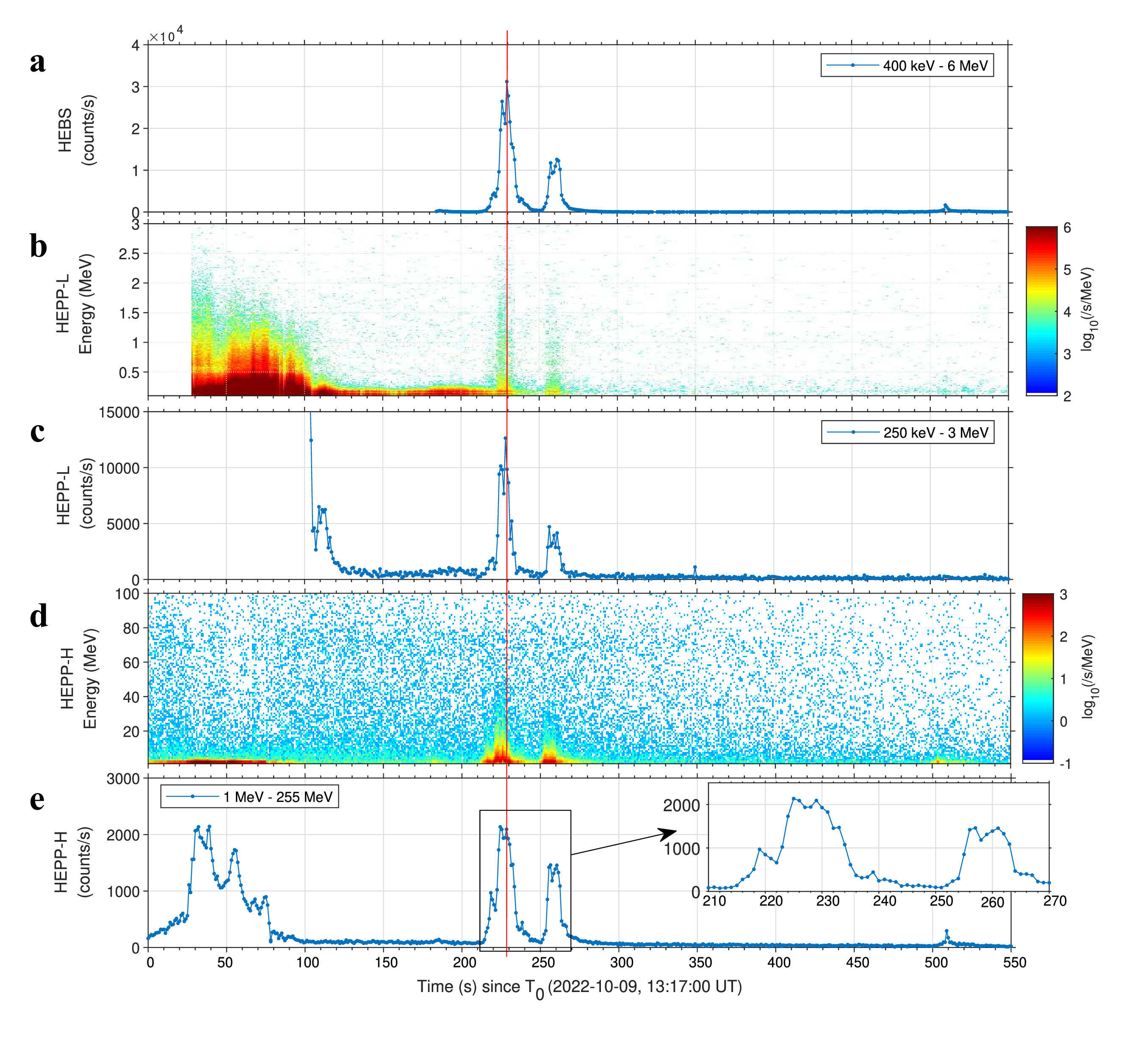 Temporal evolution of GRB 221009A observed by GECAM-C and CSES-01: (a) the gamma-ray light curve recorded by GECAM-C; (b, c) the energy-time distribution and light curve recorded by HEPP-L; and (d, e) the corresponding measurements from HEPP-H. The vertical red line marks the main emission peak. (Image by the research team)
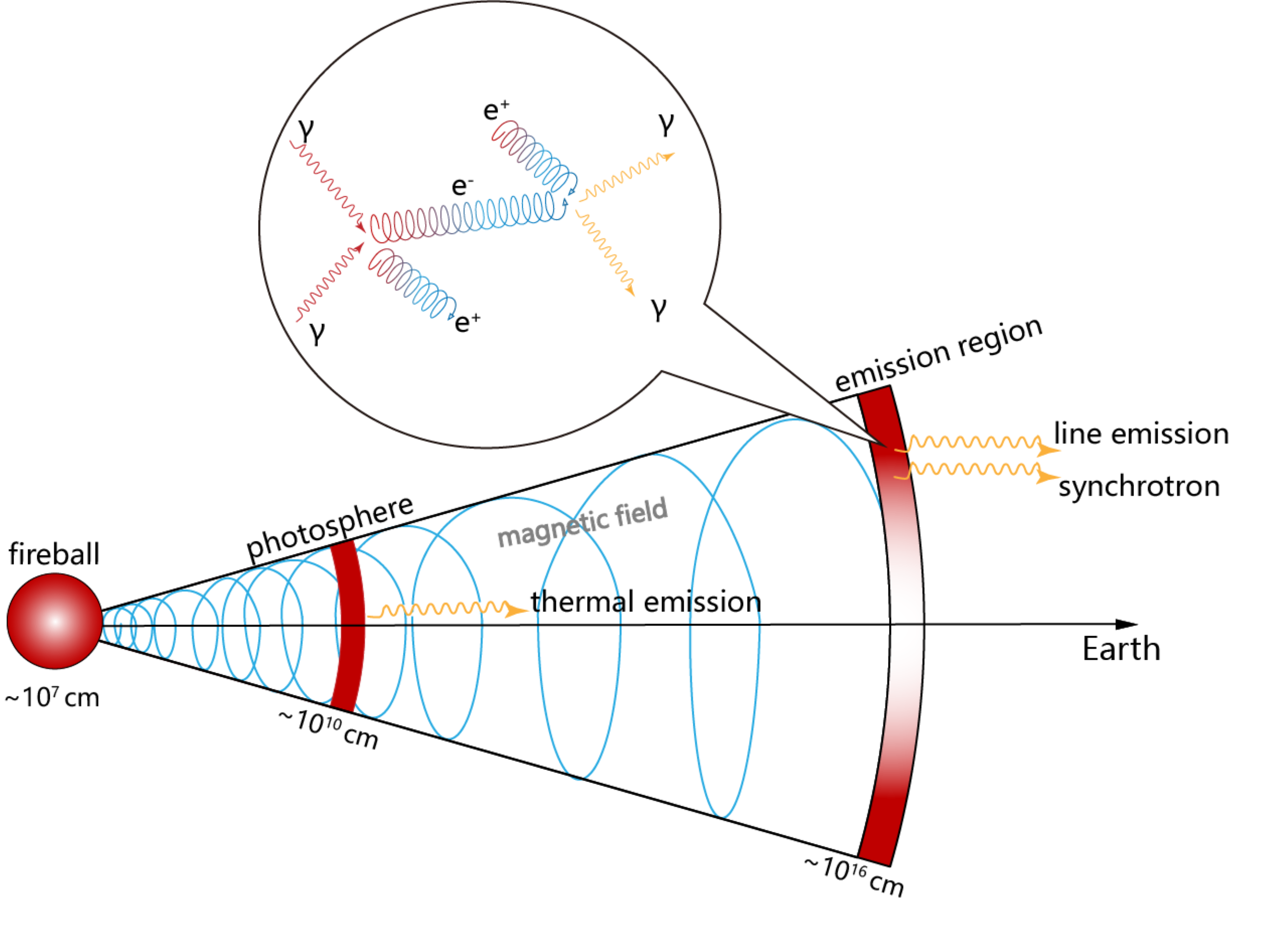 The radiation picture of GRB 221009A: the yellow wave at the photosphere represents the ~2 MeV thermal emission, while the red ring-like region depicts the jet’s angular structure; the upper and lower yellow waves represent the narrow emission line and synchrotron radiation, respectively. (Image by the research team)