Non-Resonant Inelastic X-ray Scattering Reveals Electronic Excitation Dynamics of C₆₀
A joint team from Prof. ZHU Linfan’s group the University of Science and Technology of China (USTC) and Dr. XU Wei’s team at the Institute of High Energy Physics (IHEP) of the Chinese Academy of Sciences, for the first time, measured the absolute dynamic structure factor of C60 (fullerene) molecules over wide energy and momentum ranges using the “Qiankun”spectrometer at the high energy resolution spectroscopy beamline ID33 of the High Energy Photon Source (HEPS), and has revealed a new non-dipole excitation at 24 eV. The results were published on October 1 in The Journal of Chemical Physics with the title "Momentum-resolved non-resonant inelastic x-ray scattering study of C₆₀", and the paper was selected as an Editors' Pick. This work also marks the first user scientific result from the ID33 beamline.
Since its discovery in 1985, C60 has remained a central research subject in physics and chemistry owing to its highly symmetric geometry and unique electronic properties. C60 possesses a dual identity as both a "molecule" and a "cluster": its valence electrons are highly delocalized and exhibit pronounced collective excitation behavior, whereas its core electrons retain a localized, atomic character. This coexistence of "collective valence-electron response" and "localized core-level transitions" makes C60 an ideal model system for studying the transition from isolated atoms to bulk-like clusters. However, for large molecular systems such as C60, accurate ab initio calculations of the electronic excitations remain highly challenging, making experimental measurement the only means of revealing its electronic excitations. Previous experimental studies based on electron energy loss spectroscopy and inelastic x-ray scattering were either limited to narrow momentum-transfer ranges or provided only relative cross sections, leaving the momentum-transfer-dependent excitation mechanisms in the electronic structure of C60 incompletely understood.
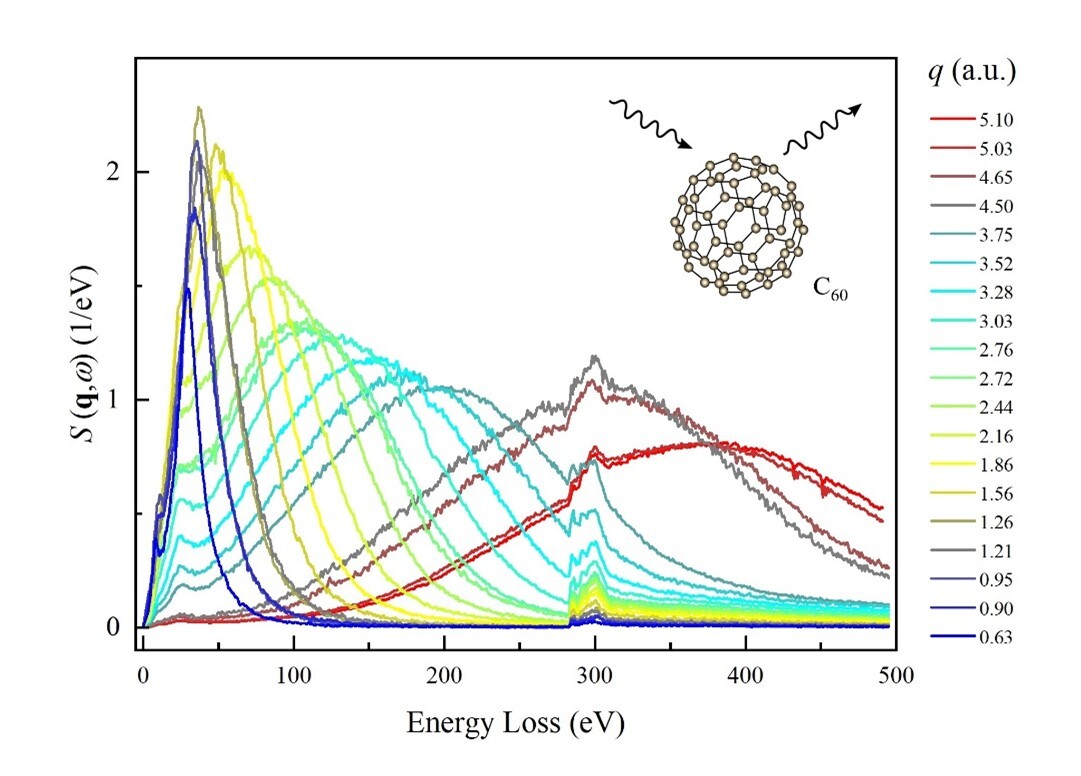
Fig. 1. Absolute dynamic structure factor S(q, ω) of C₆₀ at different momentum transfers. (Image by USTC)
Using the ID33 beamline at HEPS with an incident photon energy of approximately 10 keV and an energy resolution of 1.0 eV, the team obtained the absolute dynamic structure factor S(q, ω) of C60 over an energy-loss range of 5–500 eV and a momentum transfer range of 0.63–5.10 a.u., revealing the complete energy–momentum–excitation probability three-dimensional information of C60, as shown in Fig. 1. The experiment also identified a non-dipole transition at 24 eV and yielded high-precision generalized oscillator strengths for the core excitations. The outstanding performance of HEPS and the “Qiankun” spectrometer at the ID33 beamline made these results possible: the fourth-generation synchrotron radiation offers extremely high brightness, an improvement of 2 orders of magnitude over third-generation synchrotron radiation; and the “Qiankun” spectrometer, with five detector modules and a total of 75 energy-analyzing crystals in the vertical (Qian) and horizontal (Kun) scattering planes, can simultaneously measure scattered-photon signals at up to 25 angles, greatly improving the experimental efficiency and count rates and making both the identification of weak non-dipole excitation signals and cross section measurements over wide energy and momentum ranges possible. This work demonstrates the brilliant performance of the “Qiankun” spectrometer, which provides powerful inelastic x-ray scattering methodology for studying the electronic excitation dynamics of complex molecular systems.
The reviewers highly appreciated this work: "The research is exceptional, …and the resulting absolute GOS (Generalized Oscillator Strength) data, which covers 5–500 eV of excitation energy, is of excellent quality."; Another reviewer further noted: "Relative to other NRIXS studies of C60, this study is distinguished by the larger excitation energy covered and the quantitative nature of the derived GOS results. A very impressive study."
The first author of the paper is TANG Ruiqi, a doctoral student at USTC. The corresponding authors are CHEN Jinfeng (USTC), XU Wei (IHEP, Chinese Academy of Sciences), and ZHU Linfan (USTC). This work was supported by the National Natural Science Foundation of China, the National Key Research and Development Program of China, and the Guangdong Basic and Applied Basic Research Foundation.
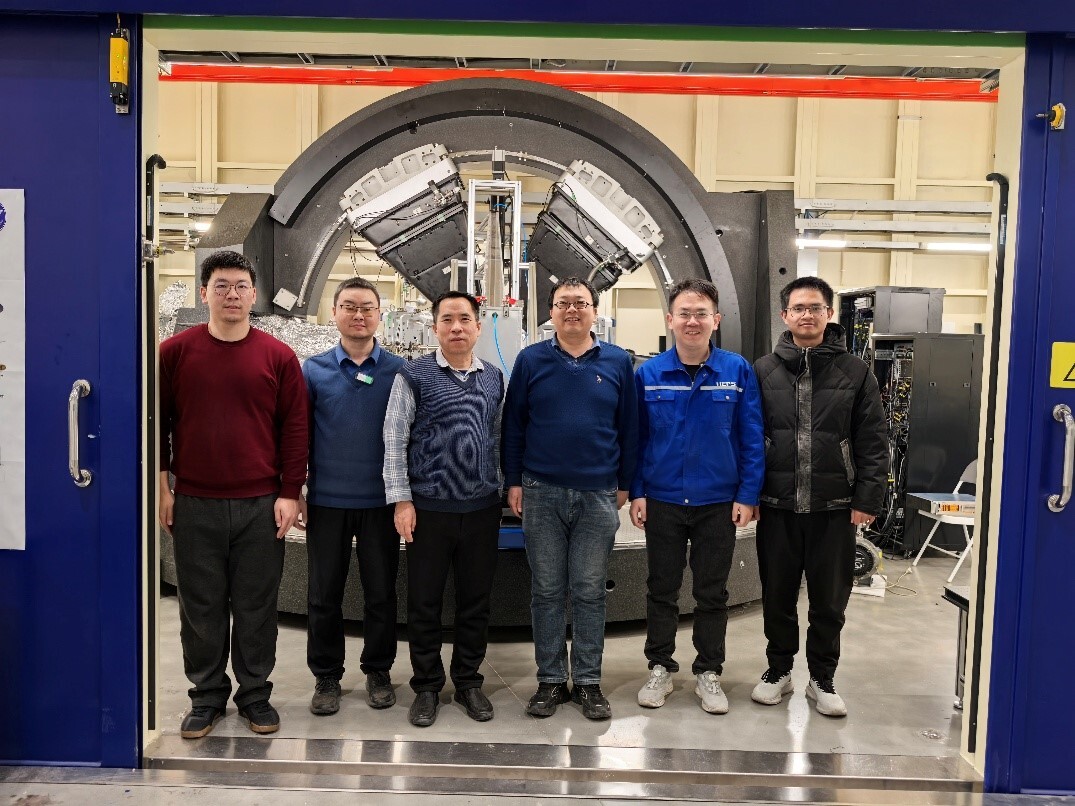
Fig.2 Photo taken at ID33 after the experiment (from left to right: TANG Ruiqi, GUO Zhiying, ZHU Linfan, XU Wei, ZHANG Yujun, CHEN Jinfeng) (Image by IHEP)
Paper link: https://doi.org/10.1063/5.0353785