Synchrotron Insights Unlock Prussian Blue-mediated Stabilization of Scalable Perovskite Photovoltaics
Perovskite solar cells (PSCs) have attracted extensive attention owing to their outstanding photovoltaic performance and potential for large-scale applications. However, during thin-film formation, perovskite materials often suffer from uncontrolled nucleation, complicated intermediate-phase evolution, residual strain, lattice disorder, and ionic defects. These structural imperfections can accelerate ion migration under operational conditions, including light illumination, thermal stress, and electric fields, ultimately limiting the efficiency, stability, and scalability of perovskite photovoltaic modules.
To address these challenges, the research team introduced a lattice-compatible Prussian blue (PB) framework as a structural template and employed advanced synchrotron-based characterization techniques at the Beijing Synchrotron Radiation Facility (BSRF) of the Institute of High Energy Physics of the Chinese Academy of Sciences. Using the 1W1A and 1W1B beamlines, the researchers performed in situ grazing-incidence wide-angle X-ray scattering (GIWAXS) and X-ray absorption fine structure (XAFS) measurements, respectively, providing insights into the role of PB from both crystallization kinetics and local coordination chemistry perspectives.
In situ GIWAXS measurements revealed that the PB framework effectively regulates the crystallization pathway of perovskite films by transforming uncontrolled homogeneous nucleation into a more ordered heterogeneous nucleation process. The presence of PB suppresses the formation of solvated intermediates and non-photoactive δ-FAPbI3 phases, while facilitating a more direct transition toward the photoactive α-FAPbI3 phase. Such controlled crystallization dynamics promote preferential crystal growth along the (100) orientation and significantly alleviate tensile lattice strain within the perovskite films.
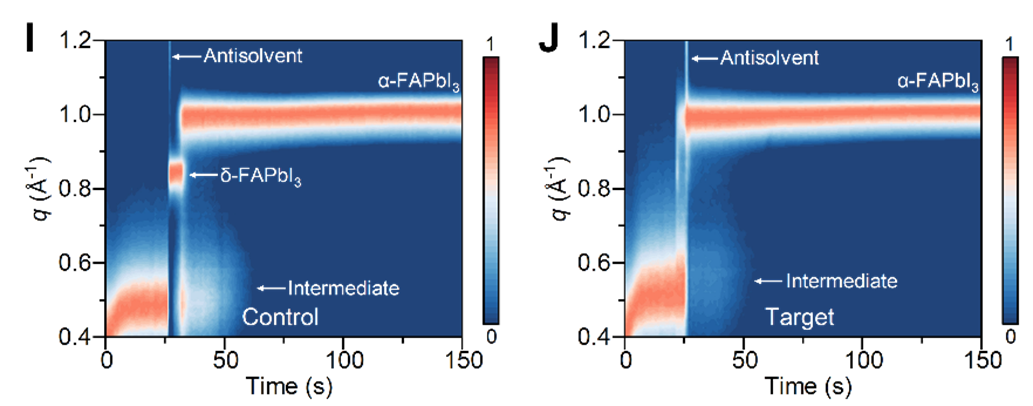
Figure 1. In situ GIWAXS reveals the role of Prussian blue in regulating perovskite nucleation and phase transformation dynamics. (Credit: XMU & IHEP)
Further XAFS analysis demonstrated that the PB framework maintains structural integrity during cation incorporation and redox processes. Even after Cs+ ions were introduced into the PB lattice channels, Fe3+ species underwent reduction while the characteristic Fe–C≡N–Fe cubic coordination framework remained intact, with negligible variation in the primary coordination distances. These results indicate that PB can simultaneously accommodate and immobilize mobile cations while preserving its robust framework structure, providing a structural basis for continuously regulating defect evolution and suppressing ion migration during device operation.
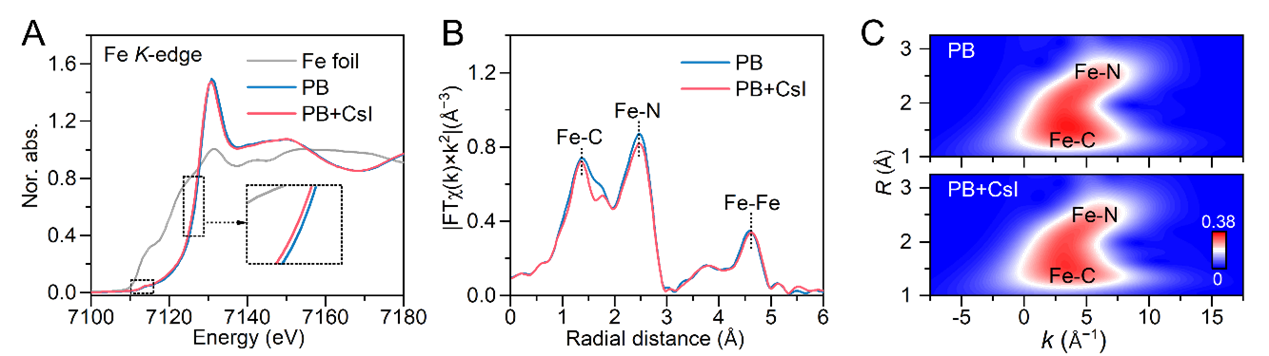
Figure 2. XAFS reveals the structural stability of Prussian blue during cation incorporation and redox processes. (Credit: XMU & IHEP)
Benefiting from the synergistic regulation of crystallization behavior and ion dynamics enabled by PB, the researchers achieved a power conversion efficiency (PCE) of 26.9% for small-area perovskite solar cells. The strategy was further validated at larger scales, delivering an efficiency of 23.4% for 6 cm × 6 cm minimodules and a certified efficiency of 22.9% for 30 cm × 30 cm perovskite submodules.
The synchrotron characterization played a critical role in uncovering the underlying mechanisms. At the BSRF 1W1A diffuse scattering beamline, Senior Engineer CHEN Yu developed and optimized a compact in situ measurement platform through multiple iterations. The setup enabled dynamic GIWAXS monitoring of perovskite film formation processes, including precursor solution coating, antisolvent treatment, and thermal annealing under inert atmosphere conditions. These measurements provided direct experimental evidence for understanding PB-mediated nucleation and crystallization evolution.
Meanwhile, in collaboration with Associate Researcher AN Pengfei at the BSRF 1W1B XAFS beamline, the research team optimized the XAFS experimental protocols and obtained high-quality Fe K-edge spectra. Combined with X-ray absorption near-edge structure (XANES) analysis, extended X-ray absorption fine structure (EXAFS) fitting, and wavelet transform analysis, the local coordination environment and structural evolution of PB were systematically characterized.
Together, these synchrotron-based investigations provided essential experimental support for elucidating how Prussian blue regulates perovskite crystallization, defect evolution, and ion migration, offering new insights into the development of efficient and stable large-area perovskite photovoltaic technologies.
The work, entitled “Prussian blue regulates ion dynamics in perovskite solar cells,” has been published in Science on September 24.
DOI: https://doi.org/10.1126/science.aef5487