Next Frontiers in Magnetic Monopole Searches: International Workshop Held at IHEP
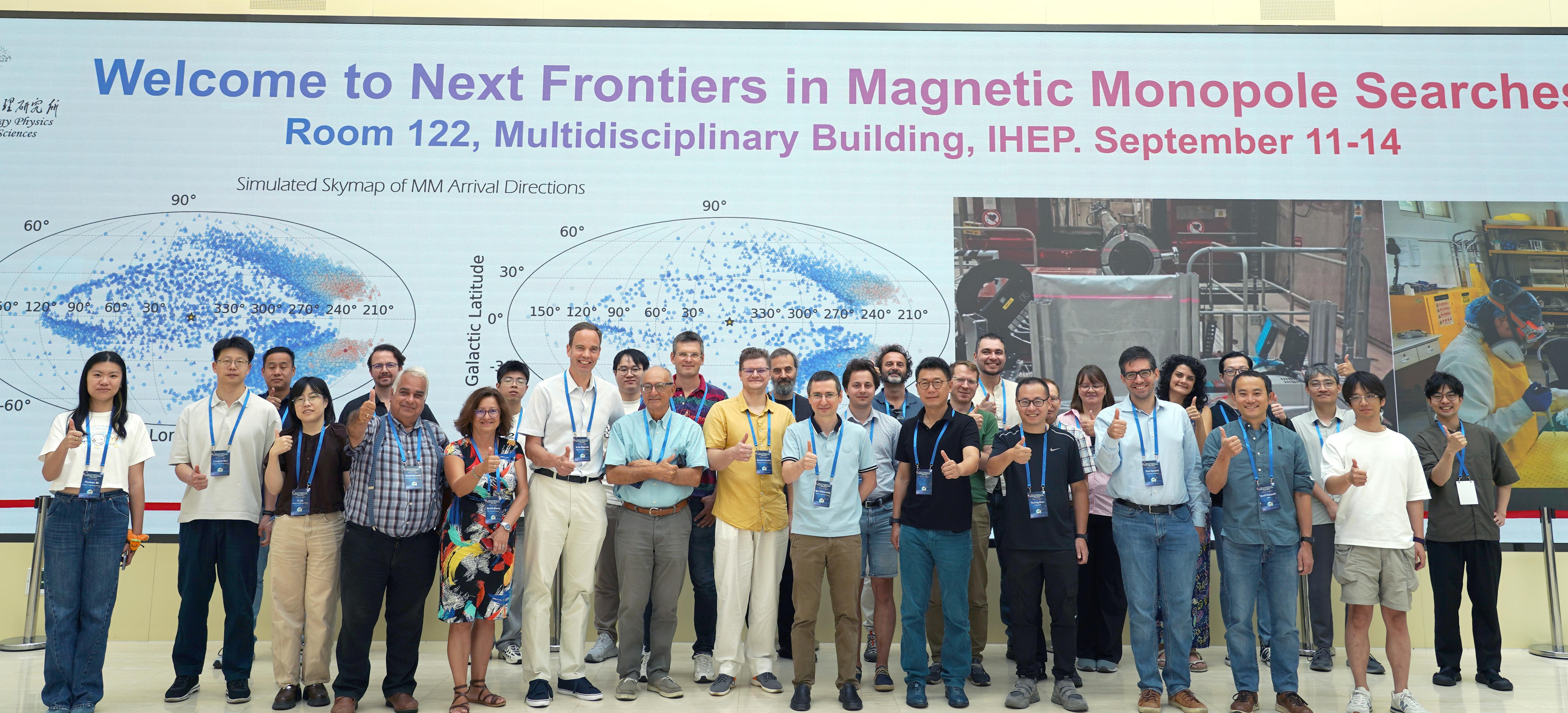
From September 11 to 14, the international workshop “Next Frontiers in Magnetic Monopole Searches” (NFMMS'26) was held at the Institute of High Energy Physics (IHEP) of the Chinese Academy of Sciences, in Beijing. The workshop brought together 46 participants from ten countries — theorists, cosmic-ray physicists, particle experimentalists, and instrument developers — to chart the path for the next-generation dedicated search for magnetic monopoles in cosmic rays. At the opening session, Prof. WEN Liangjian, deputy director of IHEP, welcomed the participants and reaffirmed IHEP’s commitment to leading this new experimental program.
Magnetic monopoles are a robust prediction of Grand Unified Theories and of a broad class of extensions of the Standard Model. Recent model-building has motivated monopoles with masses far below the traditional GUT scale; since the next collider capable of directly probing these models is decades away, the search must, on a realistic timescale, be pursued in the cosmic-ray flux. This requires a detector of very large area, placed at high altitude — a combination that defines the central technical challenge of the field: scalability.
The workshop therefore aimed to formalise a concrete experimental proposal, named MANDATE (Monopole And Nuclear Detector At Tibetan Elevation), and to define its physics case, detector design, deployment strategy and timeline. A key focus was the distinct advantage of coupling a dedicated monopole search with an existing cosmic-ray observatory, such as LHAASO, to maximise sensitivity and scientific reach.
The scientific program was organised around six themes: theory and phenomenology; the experimen tal landscape (past and present searches, current limits, detection techniques); cosmic-ray synergies; searches for other highly ionising exotic particles (nuclearites, Q-balls); the MANDATE proposal itself; and the collaboration and roadmap toward a Conceptual Design Report (CDR).
The program combined invited overview talks, contributed talks, and two dedicated discussion sessions. The first addressed the open questions in the field — a “wish list” to theorists, and the key design choices for MANDATE.
The second was devoted to the CDR roadmap, including its structure, section ownership and editorial process:
Specific physics topics discussed included the updated Parker bound and its implications for the maximum allowed monopole flux; Schwinger pair production in heavy-ion collisions and in strong astrophysical magnetic fields; the anisotropy of arrival directions for low-mass relic monopoles, which has direct implications for the design of a dedicated search; and the projected sensitivity reach of MANDATE across the monopole mass, charge and velocity parameter space.
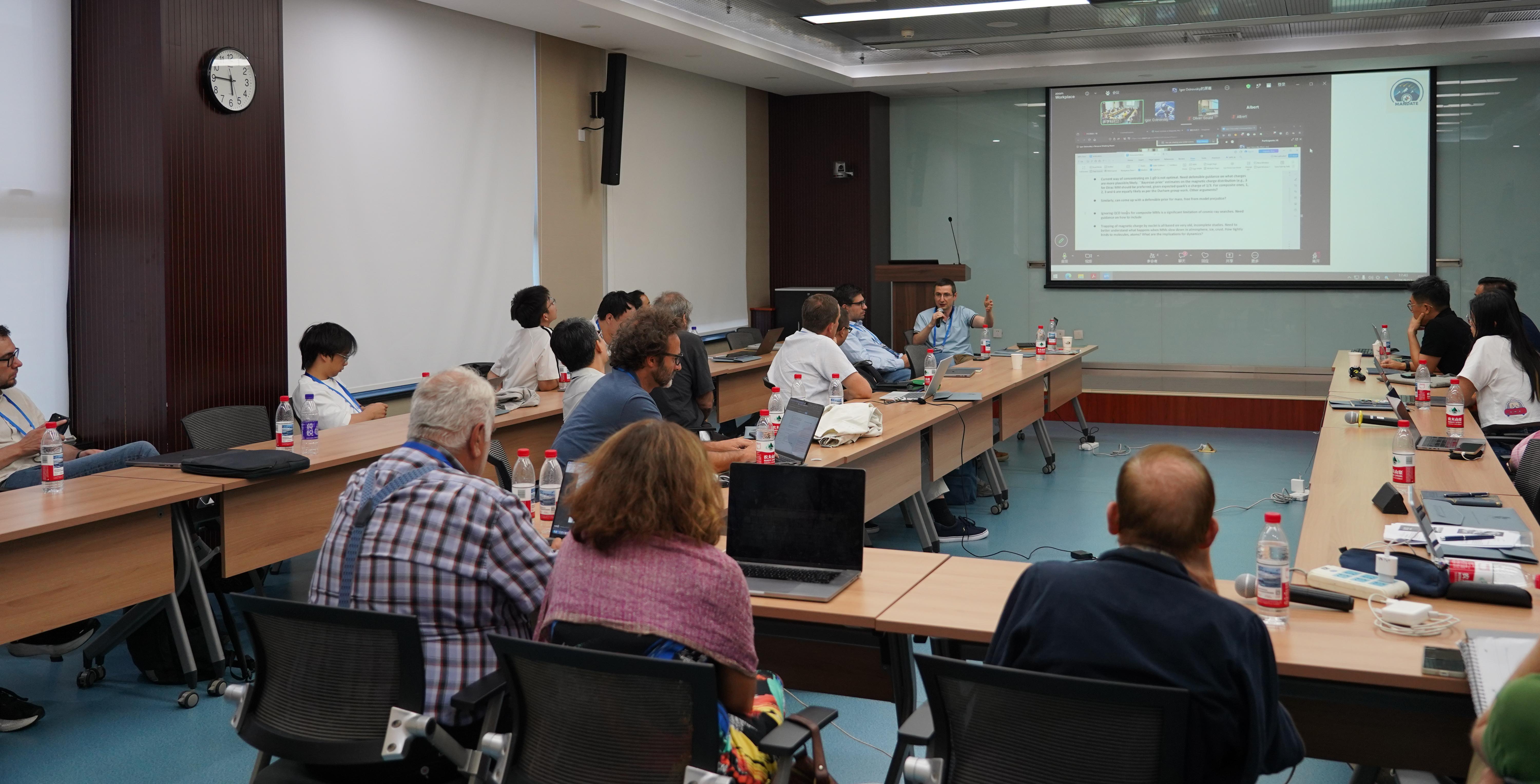
The workshop concluded with an agreed plan toward a CDR. The document will set out the physics motivation, experimental design, deployment options and timeline for MANDATE, and will serve as the foundation for seeking institutional support and launching a new dedicated experiment.
Named section editors and an editorial process were established, with a target date for the first complete draft.
The workshop also confirmed that the pilot deployment at Haizi Mountain — 10 m2 of nuclear track detectors, running since May 2026 — is producing the first background measurements (radon and neutron flux) and exercising the LHAASO joint trigger.
A second edition of the workshop is under discussion for 2027, with proposals to host at locations in Italy and China already received, reflecting the fast pace expected of both the MANDATE instrument and the CDR writing.
Further information, including the full program and contributions, is available on the Indico page of the event: https://indico.ihep.ac.cn/event/28485/.