BESIII Experiment Identifies X(2370) as a Glueball Dominated Particle
At the International Conference on High Energy Physics held in Brazil, the BESIII Collaboration at the Beijing Electron Positron Collider announced in a special plenary report that after fifteen years of sustained research, the BESIII Collaboration identified that the dominant constituent of the X(2370) is a pseudoscalar glueball with spin-parity quantum numbers of 0⁻⁺.
The strong interaction force tightly binds the quarks inside protons and neutrons. Its mediator is called the gluon, just as the photon mediates the electromagnetic interaction. Notably, however, gluons can attract each other and form an entirely new particle -- a bound state called glueball. The glueball is an important prediction of quantum chromodynamics, the theory that describes the strong interaction, and is also the only type of particle in nature composed entirely of force mediators; no particle of this kind has ever been observed experimentally, and its existence constitutes a crucial test of quantum chromodynamics. Experimental searches for glueballs have continued for half a century and remain one of the major unresolved scientific questions. The Beijing Electron Positron Collider can produce large numbers of J/ψ particles; their decays provide one of the best avenues to search for glueballs, and searching for glueballs has been one of the collider’s primary physics goals for decades.
The BESIII Collaboration discovered a new particle in J/ψ decays, called the X(2370), in 2011. Following another 13 years of work, the Collaboration used a much larger sample of 10 billion J/ψ particles in 2024 to determine for the first time its spin and parity quantum numbers to be 0⁻⁺. Its mass and quantum numbers are in complete agreement with lattice-quantum-chromodynamics prediction for a pseudoscalar glueball (whose spin and parity is 0⁻⁺), marking a crucial step toward establishing its true identity.
Recently, the BESIII Collaboration discovered several new decay modes of the X(2370) and, in particular, determined for the first time its “flavor-singlet” nature, which is the most important characteristic of a glueball. This series of BESIII studies established a complete chain of experimental evidence: a pseudoscalar-glueball component must dominate the X(2370). This is the clearest experimental result from nearly fifty years of searches for glueballs, verifying the major theoretical prediction that gluons can bind together to form a new type of matter. This result demonstrated unique advantages of the Beijing Electron Positron Collider in studies of strong interactions.
The above results were officially released at 4:00 p.m. local time in Brazil on August 5 in the form of a special plenary report at the International Conference on High Energy Physics.
Why Is This Discovery Important?
The discovery of the glueball is a direct test of the non-Abelian gauge structure of quantum chromodynamics (QCD). While the discovery of asymptotic freedom established the foundation of QCD as the correct theory, the existence of the glueball provides decisive validation of the theory at low energies. Glueballs also represent an entirely new form of matter—matter composed of force mediators.
From a broader perspective, this discovery once again demonstrates the frontier-exploration capabilities of large-scale scientific facilities. Since the major upgrade of the Beijing Electron Positron Collider was completed in 2008, the BESIII detector has accumulated more than 10 billion J/ψ events, making it the undisputed world leader in the tau-charm energy region. This discovery exemplifies the integration of sustained accumulation, precision measurement, and international collaboration.
Release Information:
At 4:00 p.m. local time in Brazil on August 5, 2026, the BESIII Collaboration formally presented the detailed results to the global physics community at a plenary session of the International Conference on High Energy Physics (ICHEP 2026). A preprint containing the recent findings is available as arXiv:2607.20366 [hep-ex].
About BESIII:
For more information, please visit the BESIII website: http://bes3.ihep.ac.cn
The Beijing Spectrometer III (BESIII) is a large particle-physics detector operating at the Beijing Electron Positron Collider II (BEPCII), and its international collaboration comprises approximately 700 scientists from about 96 research institutions in 15 countries. The experiment focuses on precision physics in the tau-charm energy region and has achieved a series of world-leading results in hadron spectroscopy, charm physics, tau physics, and searches for physics beyond the standard model. The highly efficient work of the BESIII detector team and the BEPCII accelerator operations and maintenance team during data taking, as well as that of the BESIII offline-software team and the Computing Center of the Institute of High Energy Physics, Chinese Academy of Sciences, during data analysis, provided essential support for this discovery.
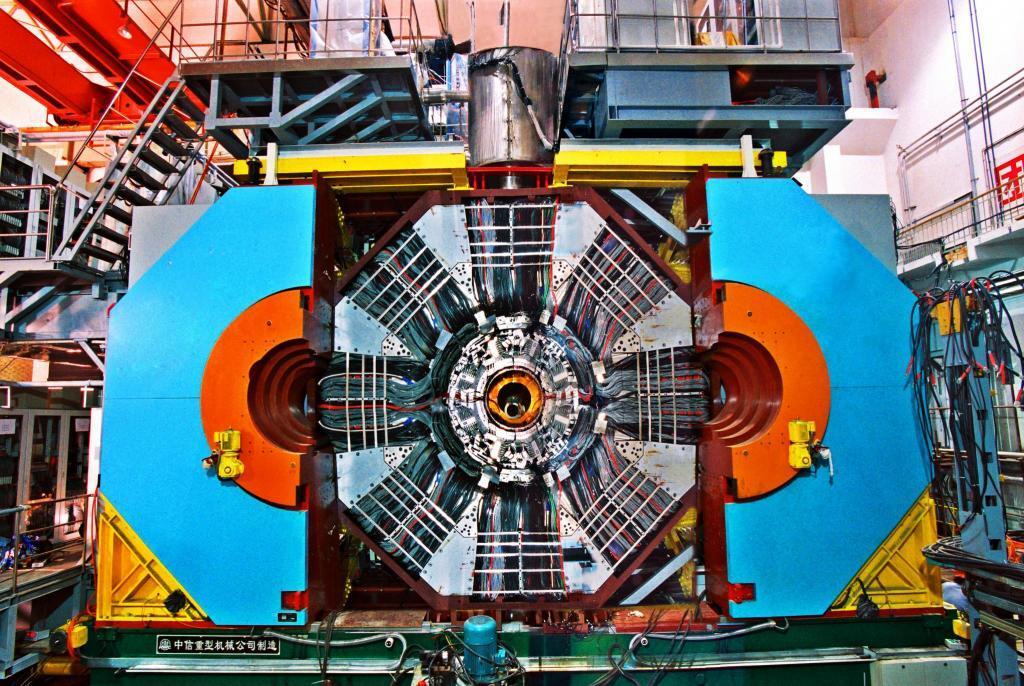
Figure: BESIII (Credit: BESIII Collaboration)
Related News

Second Polarized Neutron Workshop Held in Dongguan
12-21,20
IHEP held the 2nd Workshop on Polarized Neutrons in Dongguan on Dec. 10-14, 2020. Due to an inte...

BESIII reports the most precise measurements of strong-phase parameters in D->KS/Lπ+π-
06-19,20
The BESIII collaboration has reported the most precise measurements to date of the relative stron...