A Novel Method for Detecting Cosmic Neutrino Background
Recently, Professor ZHOU Shun from the Institute of High Energy Physics of the Chinese Academy of Sciences, and Professor HUANG Guoyuan from China University of Geosciences (Wuhan) have jointly proposed a novel method for detecting the Cosmic Neutrino Background (CνB). The main strategy is to capture the signals of relic neutrinos from the Big Bang by leveraging the parametric fluorescence effect, and the relevant results were published online in Physical Review Letters on February 24 [Phys. Rev. Lett. 136 (2026) 081003].
The standard Big Bang cosmology predicts that neutrinos decoupled to form a background about 1 second after the birth of the universe, and thus they carry key information about the early evolutionary history of the universe. With the expansion of the universe, the temperature of the cosmic neutrino background today is merely 1.95 Kelvin (approximately -271.2 degrees Celsius), which results in an extremely small probability for these neutrinos to interact with matter, making them elude direct detection to this day. For a long time, the detection of the cosmic neutrino background has been one of the major challenges in the fields of particle physics and astrophysics. This research breaks new ground: it utilizes the coherent scattering of cosmic background neutrinos with low-temperature atomic or molecular systems to induce the parametric fluorescence effect (νᵢ + M → νⱼ + γₛ + M), and indirectly captures the cosmic neutrino background signals by detecting the emitted infrared photons γₛ. In this process, due to the small momentum of cosmic background neutrinos, the energy difference between the initial-state neutrino νᵢ and the final-state neutrino νⱼ is mainly determined by their mass difference, while the atomic or molecular state M remains unchanged before and after the reaction.
The results show that when the energy transferred by neutrinos matches the molecular energy level difference, a resonance enhancement occurs, and the signal event rate is proportional to the square of the system's coherence time. Under conservative parameters (a coherence time of 10 nanoseconds and a target volume of 5 cubic meters), the annual event rate can reach 1. With optimized parameters (a coherence time of 10 microseconds and a target volume of 40 cubic centimeters), the annual event rate is expected to rise to 8. In addition, the slow light effect and electromagnetically induced transparency technology can effectively address the issues of photon attenuation and energy dispersion, further enhancing the feasibility of detection.
This method does not rely on the electromagnetic properties of neutrinos and can achieve signal amplification solely through the weak interaction, blazing a completely new trail for the detection of the cosmic neutrino background. The successful detection of the cosmic neutrino background will not only verify the Big Bang cosmology and reveal the laws of the early cosmic evolution but also provide a new window for measuring neutrino mass and exploring their Majorana nature.
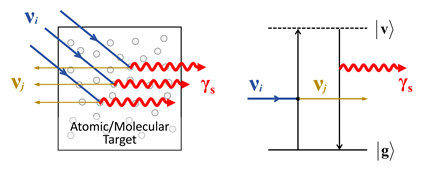
Figure: Coherent scattering of cosmic background neutrinos with atomic or molecular systems induces the parametric fluorescence in the latter, where |v⟩ and |g⟩ represent the excited and ground energy levels of molecules, respectively (Credit: IHEP).
Paper link: https://link.aps.org/doi/10.1103/f4zt-bbzv