Tibet ASγ Experiment Sheds New Light on Cosmic Rays Acceleration and Propagation in Milky Way
The Tibet ASγ Experiment has successfully, for the first time, measured magnetohydrodynamic (MHD) turbulence on scales below one parsec (approximately 3.3 light-years) within the gamma-ray halo surrounding the Geminga pulsar wind nebula (PWN). This pioneering observation extends to the highest energies, above 100 tera-electron volts (TeV), providing unprecedented insights into the behavior of cosmic rays and magnetic fields within the Milky Way. The findings were published in Science Advances on March 4. The study was conducted by the Tibet ASγ Eexperiment, including the Institute of High Energy Physics of the Chinese Academy of Sciences (CAS) and the National Astronomical Observatories of CAS.
Geminga, a nearby ancient pulsar located about 250 parsecs (approximately 800 light-years) from Earth, serves as an ideal laboratory for simultaneously exploring the acceleration and propagation mechanisms of cosmic rays. The research team observed the energy spectrum of electrons/positrons injected by the Geminga PWN and discovered a cutoff around 100 TeV. This marks the first direct evidence indicating that the acceleration limit for electrons in this system is approximately 100 TeV.
Furthermore, the team measured the extent of the gamma-ray halo across an energy range from approximately 16 TeV to 250 TeV. Through analysis, they found that the diffusion coefficient near Geminga is only about 1/100 of the average value in the Milky Way's galactic disk, demonstrating that particle diffusion is strongly suppressed in this region. These results are highly significant for understanding the acceleration and propagation of cosmic rays (electrons and positrons) within PWN.
Critically, the team has confirmed for the first time that the MHD turbulence in the region surrounding the Geminga PWN follows Kolmogorov-type turbulence (see Fig.1). This represents the world's first experimental determination of MHD turbulence characteristics on scales below one parsec. Scientists were surprised to find that Kolmogorov-type turbulence, previously inferred from measurements on much larger scales in the galactic disk, persists even at these minuscule scales. The turbulent properties derived from the Geminga halo are in excellent agreement with extrapolations from larger-scale galactic disk measurements (see Fig.1). These results are highly significant for understanding the acceleration and propagation of cosmic rays (electrons and positrons) within PWN.
Notably, the results also indicate that the galactic disk exhibits stronger magnetic turbulence compared to the halo. Additionally, the research proposes that the origin of the strong turbulence around the Geminga PWN might be an environmental effect, opening new avenues for understanding the complex interplay between pulsars and their surrounding environments.
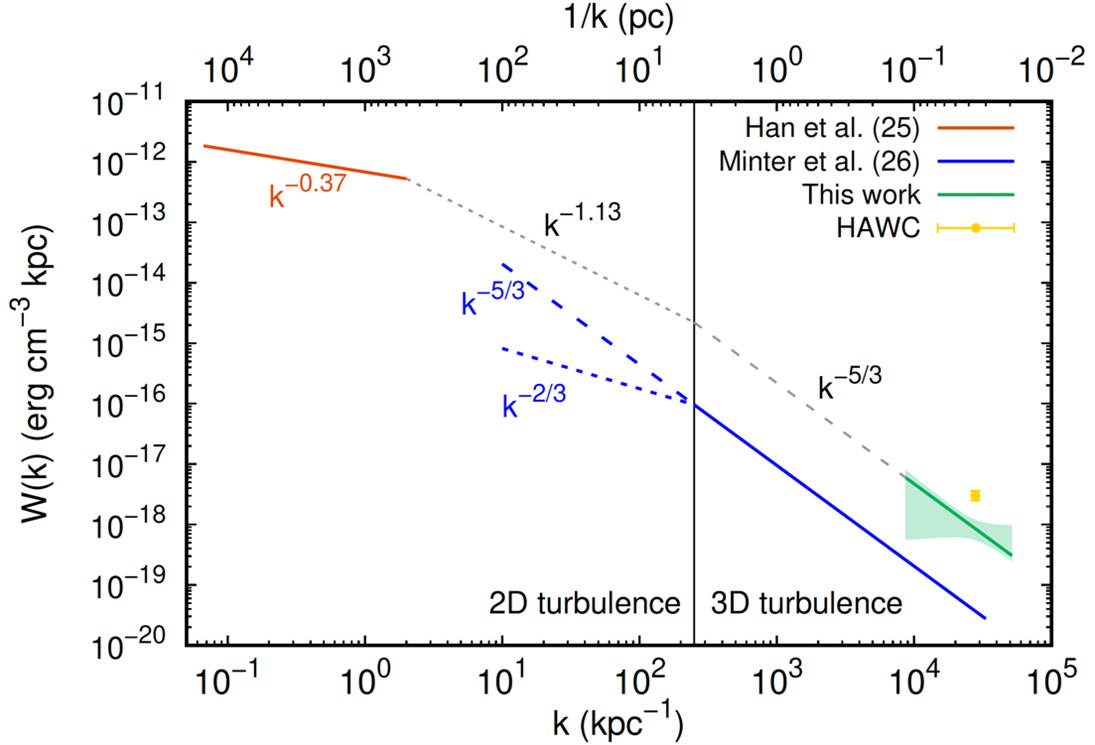
Fig.1: The power spectrum of magnetic turbulence measured by the Tibet ASγ experiment (green shadow) in comparison with those measured by Minter et al. (blue solid line) and Han et al. (red solid line). The yellow point is derived from the diffusion coefficient measured by HAWC. The turbulence is three-dimensional at a scale below ∼4 pc, whereas it gradually turns to be two-dimensional above ∼4 pc. For three-dimensional turbulence, the spectral index of -5/3 is expected from the Kolmogorov theory. (Image by IHEP)
The Tibet ASγ experiment, located in Yangbajing town, Tibet, at an altitude of 4,300 m above sea level, has been operating jointly by China and Japan since 1990. The China-Japan collaboration added a new Underground Muon Detector array (MD: 3,400 m2) under the existing cosmic-ray detectors (Tibet-III: 65,700 m2) in 2014 (see Fig.2). These underground muon detectors suppress 99.92% of the cosmic-ray background noise, significantly improving the sensitivity. As a result, the experiment was able to detect gamma rays above 100 TeV from the Geminga PWN with high precision under low background noise.
This groundbreaking work marks a significant step forward in our understanding of cosmic ray propagation and magnetic field dynamics in the universe. These results are expected to have far-reaching implications for future multi-messenger and high-energy gamma-ray studies.

Fig.2: The Tibet ASgamma experiment (Tibet-III array+ Underground Muon Detector array). (Image by IHEP)
Online URL: https://www.science.org/doi/10.1126/sciadv.adv8173
DOI: 10.1126/sciadv.adv8173
Media Contact:
1) Ms. JIA Yinghua (jiayh@ihep.ac.cn), Institute of High Energy Physics, CAS
2) Prof. HUANG Jing (huangjing@ihep.ac.cn), for the Tibet ASγ experiment, Institute of High Energy Physics, CAS