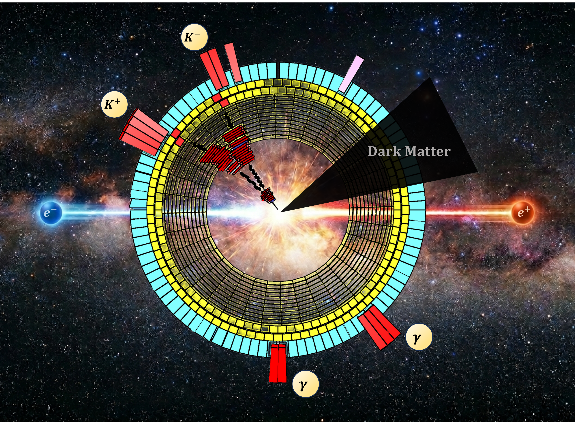
The BESIII Collaboration recently reports the search for sub-GeV dark particles in η→π⁰+invisible decay and provides a new bound for the sub-GeV dark matter, which has been published in Physical Review Letters on 16th July, 2026 [Phys. Rev. Lett. 137, 031804] as PRL Editors Suggestion.
Figure 1: Schematic illustration of the search for and detection of sub-GeV dark matter at the BESIII experiment.
Dark matter is a non-luminous and invisible form of matter proposed to explain a wide range of cosmological observations. It accounts for approximately 84% of the total matter content of the Universe and is therefore the dominant constituent of cosmic matter. However, its fundamental properties, including its mass and interaction mechanisms, remain one of the greatest unresolved mysteries in fundamental physics. There are three primary experimental approaches to searching for dark matter: direct detection, indirect detection, and collider searches. These methods have been extensively employed in the search for heavy dark matter with masses above 1 GeV. However, no evidence for heavy dark matter has been observed, and increasingly stringent experimental constraints have been placed on such candidates. Consequently, growing attention has shifted toward lighter sub-GeV dark matter. Unlike heavy dark matter, however, the signals produced by sub-GeV dark matter through scattering with nuclei fall below the detection thresholds of conventional direct detection experiments, resulting in a substantial loss of sensitivity. As a result, a significant portion of the sub-GeV dark matter parameter space remains experimentally unexplored.
Using η meson data collected by the BESIII experiment at the electron-positron collider, a search for invisible sub-GeV dark matter particles is performed through the process η→π⁰S→π⁰χχ with exceptional experimental sensitivity, where S denotes the dark scalar mediator and χ represents the dark matter particle. This process benefits from the narrow width of the initial-state η meson, the absence of electroweak loop suppression in the flavor-conserving transition, and the lack of helicity suppression in the final state, making it highly sensitive to contributions from physics beyond the Standard Model. Furthermore, it provides an experimentally complementary probe to the dark Higgs bosons searches with Yukawa-like couplings.
No significant signal is observed. Consequently, upper limits on the branching fraction are set at the 90% confidence level to be (1.8~5.5)×10⁻⁵, while the corresponding upper limits on the coupling strength to light quarks are determined to be (1.3~3.2)×10⁻⁵.
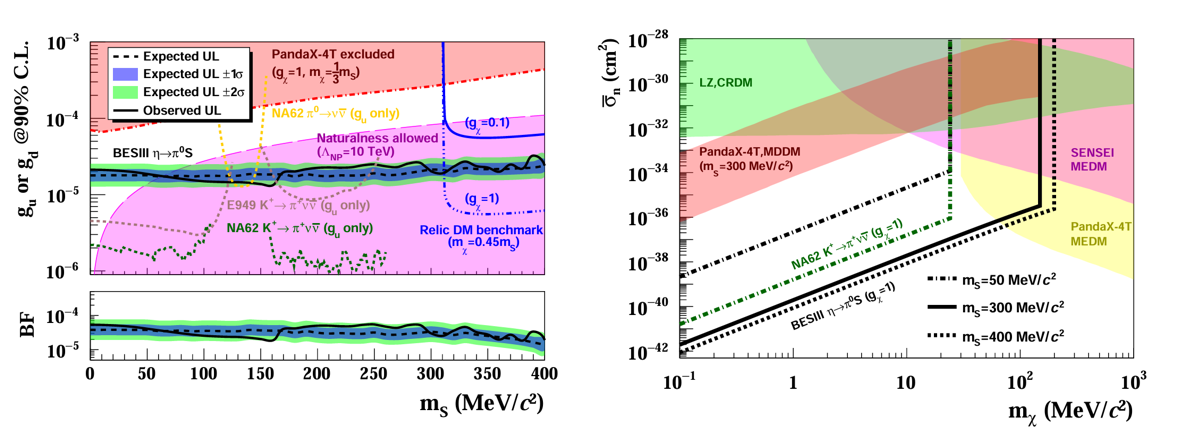
Figure 2: Experimental constraints on the coupling strength between the dark mediator and light quarks (left) and on the dark matter-nucleon scattering cross section (right).
These results surpass the sensitivity of previous direct detection experiments and probe the parameter space favored by naturalness in the effective field theory framework with a new physics scale of 10 TeV. Moreover, under the thermal freeze-out scenario in which χχ→π⁺π⁻ dominates the dark matter annihilation process, the achieved sensitivity reaches the parameter space capable of explaining the observed dark matter relic abundance. Under the model-dependent assumption that dark matter scatters off nucleons through the exchange of the dark scalar mediator S, the obtained limits improve the constraints on the sub-GeV dark matter-nucleon scattering cross section by approximately five orders of magnitude compared with previous direct detection experiments. These results are of unique and significant importance for understanding the fundamental nature of dark matter, as well as the composition and evolution of the Universe.
Link to the paper:
Journal publication: https://journals.aps.org/prl/abstract/10.1103/lbj8-qqm6