

The Large High Altitude Air Shower Observatory (LHAASO), a major national science and technology infrastructure in China, has recently made a breakthrough in exploring the extreme universe. For the first time, the collaboration has detected ultra-high-energy (UHE) gamma rays—with energies exceeding 100 TeV (100 trillion electron volts) — from a gamma-ray binary system LS I +61° 303. This discovery not only extends observations of such systems into the UHE regime but also challenges existing theories of particle acceleration in extreme astrophysical environments. The findings were published online in Physical Review Letters (Phys. Rev. Lett.) on May 6, and selected as an Editor's Suggestion. In addition, the work was also featured as a Synopsis by Physics Magazine, the official popular science journal of the American Physical Society (APS). This research was led by the Institute of High Energy Physics (IHEP) of the Chinese Academy of Sciences (CAS), with key contributions from the Shanghai Astronomical Observatory and other institutions.
The origin of high-energy cosmic rays—charged particles from outer space—remains a "century-old puzzle" in astrophysics. Searching for extreme particle accelerators capable of accelerating particles to the peta-electron volt (PeV, 1,000 trillion electron volts) is crucial to solving this mystery. Gamma-ray binaries, composed of a massive star and a compact star (either a neutron star or a stellar-mass black hole), are potential cosmic-ray accelerators and serve as natural laboratories for extreme physics. However, only a handful of binary systems are known to emit very-high-energy (VHE, > 0.1 TeV) gamma rays. As a classical gamma-ray binary, LS I +61° 303 had previously been observed only up to approximately 10 TeV, and whether it could accelerate particles to higher energies was unknown.
This breakthrough was enabled by LHAASO's exceptional sensitivity and broad energy coverage. For the first time, LHAASO has measured the energy spectrum of LS I +61° 303 up to 200 TeV, identifying it as an ultra-high-energy gamma-ray binary. Furthermore, the team discovered that the flux of the system varies with its orbital period of about 26.5 days, and this "orbital modulation" exhibits a clear energy dependence, unveiling complex internal physical processes. In binary system, the strong magnetic field causes high-energy electrons to rapidly lose energy via synchrotron radiation, which constrains electrons to be accelerated to UHE range. The detected photons above 100 TeV strongly suggest that, during specific orbital phases of the system, high-energy protons (hadrons) are accelerated and collide with dense surrounding stellar wind, producing these UHE gamma rays.
This discovery provides critical evidence that gamma-ray binaries like LS I+61° 303 are potential PeVatrons—sources capable of accelerating cosmic rays to PeV energies. It also imposes new, stringent constraints on theoretical models of particle acceleration and radiation in extreme astronomical environments, paving a new path for future multi-messenger astronomy.
This work was co-correspondingly authored by Researcher HE Huihai, Associate Researcher LI Cong, Postdoctoral Fellow XIANG Guangman, and PhD student DONG Xuqiang from the Institute of High Energy Physics, as well as Associate Researcher ZHOU Jianan from the Shanghai Astronomical Observatory. It was supported by the National Key R&D Program of China, the National Natural Science Foundation of China, and the Chinese Academy of Sciences.
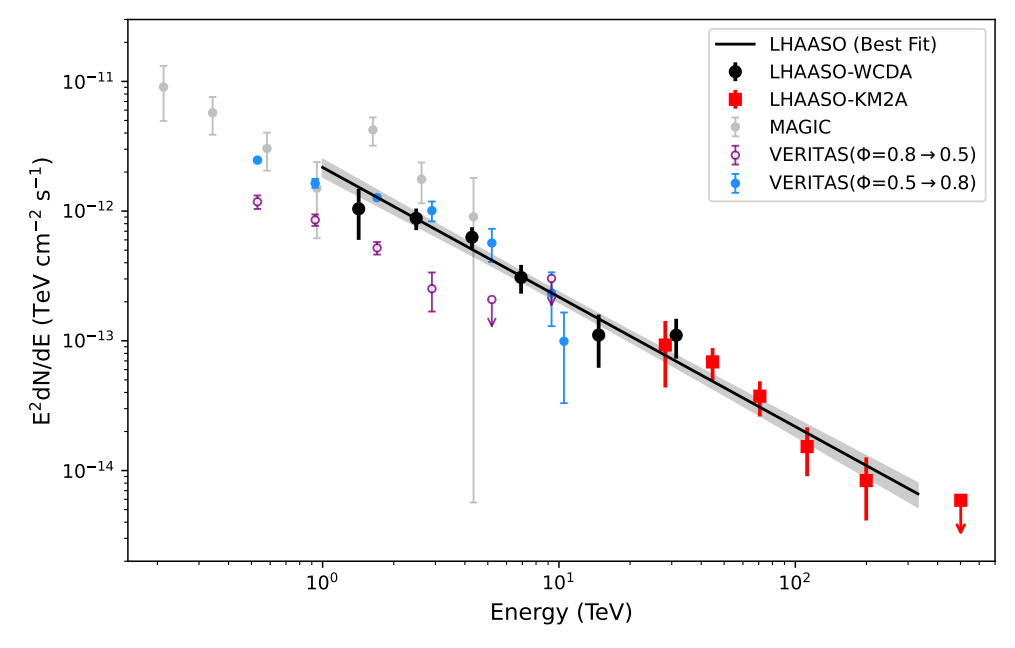
Figure. Broadband energy spectrum measurement of the gamma-ray binary LS I +61° 303. (Credit: LHAASO Collaboration)
Paper Link: https://doi.org/10.1103/7xhp-tff7