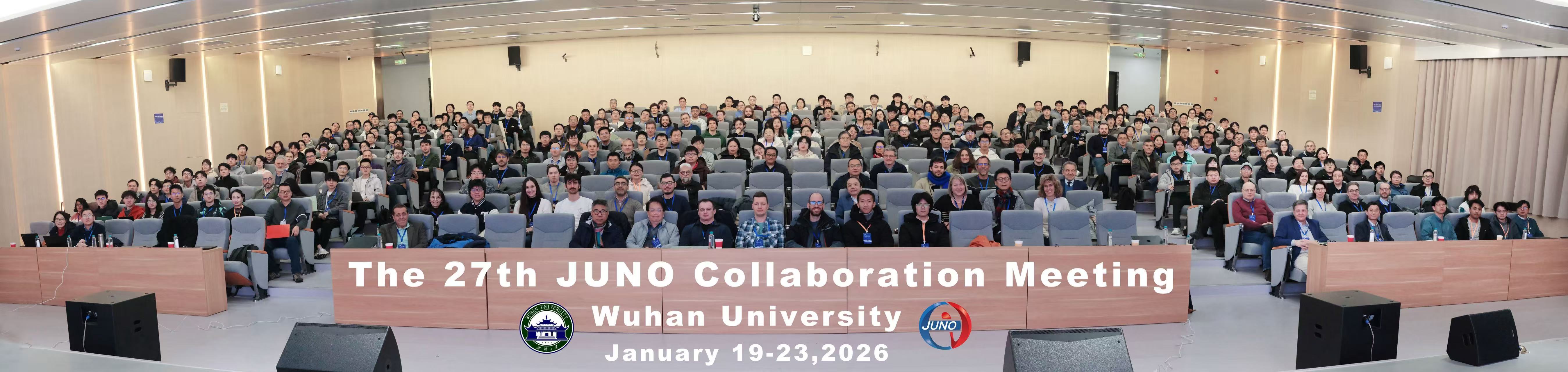
From January 19 to 23, the 27th International Collaboration Meeting of the Jiangmen Underground Neutrino Observatory (JUNO) was successfully held at Wuhan University. The meeting attracted 350 in-person participants and 15 online attendees from 13 countries and regions, setting a new record for in-person attendance since the establishment of the JUNO collaboration.
WANG Yifang, spokesperson of the JUNO collaboration, briefed the significant progresses achieved by the collaboration after a short welcome speech delivered by Professor XIAO Xiangheng, the head of the School of Physics and Technology at Wuhan University. Since the previous collaboration meeting in July 2025, JUNO has reached two major milestones. First, the liquid scintillator filling was completed on August 22, 2025 and the official physics data-taking commenced at 05:30 Beijing time on August 26, 2025. 23,231.6 cubic meters of liquid scintillator have been filled into the central detector, and 41,225.1 cubic meters of ultrapure water are contained in the surrounding water pool. Second, the collaboration released its first physics result in November 2025, achieving world-leading precision in measuring the solar neutrino oscillation parameters θ₁₂ and Δm²₂₁. The first physics result (arXiv:2511.14593) and the detector performance (arXiv:2511.14590) were released as a pair of companion papers, garnering widespread attention in the academic community. The completion of the JUNO detector and its initial achievements have sparked extensive media coverage globally, with over 1,800 reports from overseas media across 55 countries.
Working groups engaged in in-depth discussions, covering calibration methods, event reconstruction, background studies, and oscillation analysis. The detector is currently operating stably, with all subsystems meeting the design specifications. The collaboration is expected to provide a definitive answer to the neutrino mass ordering problem in the coming years. Meanwhile, preparations for extended physics topics, such as supernova neutrinos, geoneutrinos, and solar neutrinos, are actively underway.
The meeting also outlined key tasks for 2026, including upgrading computing infrastructure and analysis frameworks to prepare for the upcoming Neutrino 2026 international conference.
The 28th JUNO Collaboration Meeting will be held in Beijing in July 2026.