The central detector isfilled with 20 kton LAB based liquid scintillator.When neutrinos go through the detector, a very small part of them interact with the liquid scintillator, producing scintillation light, which can be seen by 15,000 surround 20”photomultiplier tubes (PMTs). The energy of incident neutrinos and the interaction vertex can be reconstructed based on the charge and time information of PMT. Energy resolution is roughly in inverse proportion to the square root of detected photon electrons. To reach the expected sensitivity of mass hierarchy, the energy resolution has to be better than 3% at 1 MeV, corresponding to 1,200 photon electrons per MeV, which is a much better performance than the state of the art detector such as BOREXINO and KamLAND. The technical challenges are new type of PMTs with high efficiency and highly transparent liquid scintillator.
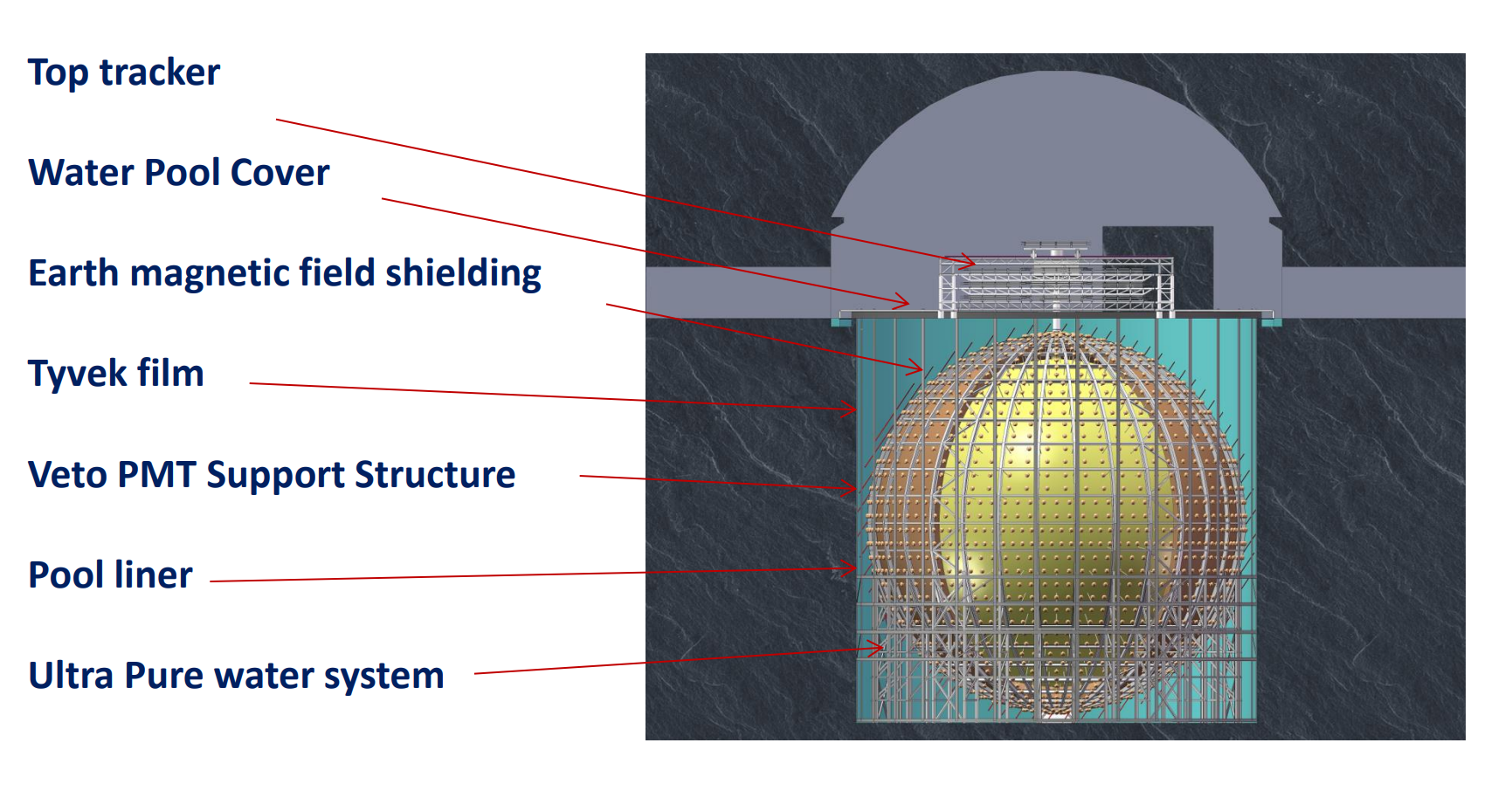
Adetector concept
The water pool protects the central detector from natural radioactivity in surrounding rocks. It also serves as a water Cherenkov detector after equipped with PMTs, to tag cosmic muons. There is another muon tracking detector on top of the water pool, used to improve muon detection efficiency and to get better muon tracking.
Signal and backgrounds
The reactor electron antineutrino interacts with proton via the inverse β-decay(IBD) reaction in the liquid scintillator, and releases apositron and a neutron. The positron depositsits energy quickly, providing a prompt signal. Theenergy of positron carries most of the kinetic energy of the neutrino.The neutron is captured by proton after an averagetime of 200μs, then releases a 2.2 MeV gamma, providing a delayed signal. The coincidenceof prompt-delayed signals provides a distinctive antineutrino signature. The estimated IBD reaction rate is ~40/day.
The dominate backgroundis accidentals, coming from two uncorrelated backgroundradiation interactions that randomly satisfy the energyand time correlation for inverse β-decay antineutrino selection. It’s designed to be below10% of IBD signals and can be precisely measured in data. Other major backgrounds are introduced by cosmic muons, including cosmogenic β-n isotope 9Li/8He and fast neutrons. Both of them are less than 1% after appropriate muon veto.
