
On April 12, 2026, Professor Pongruk Sribanditmongkol, President of Chiang Mai University (CMU), Thailand, led a delegation to the Tianfu Cosmic Ray Research Center (Tianfu CRRC). The two sides held in-depth exchanges focusing on frontier research in neutrino astronomy physics and international collaboration on the High-energy Underwater Neutrino Telescope at Lake Baikal (Baikal-HUNT) project. Attendees included Academician Zhen Cao of the Chinese Academy of Sciences (CAS), Professor and Director of the Tianfu Cosmic Ray Research Center, Professor Felix Aharonian, Professor Mingjun Chen, Principal Investigator (PI) of the Baikal-HUNT project, and several research staffs from the project.
During the visit, Academician Zhen Cao introduced the Large High Altitude Air Shower Observatory (LHAASO) and its subsequent upgrade plans to the CMU delegation. Subsequently, research representatives from both China and Thailand gave the presentations on the progress of the Baikal-HUNT project and the scope of collaboration between CMU and the project in cosmic ray and neutrino physics, followed by in-depth academic discussions. The delegation then conducted on-site tours of laboratories at the Tianfu CRRC, with a special focus on the Baikal-HUNT detector R&D laboratory, where they gained detailed insights into the R&D progress and technical specifications of core equipment including photomultiplier tube (PMT) detection units, pressure-resistant glass instrument spheres, and underwater data acquisition modules.
The Thai delegation stated that this on-site visit and academic exchange served as a critical bridge and invaluable opportunity to deepen bilateral cooperation. CMU expressed its strong willingness to participate in Baikal-HUNT, a landmark international scientific endeavor. The Thai side looks forward to continuing to deepen practical, results-oriented collaboration with the Chinese side, and will further increase its investment and strengthen its support during the project’s development phase. The Chinese side expressed heartfelt thanks to the CMU delegation for their visit and the fruitful in-depth exchanges, and supports the ongoing contributions made by the Thai team to the project. The Chinese team is ready to continue working hand in hand and closely collaborating with the Thai team to jointly promote the early official approval and initiation of the Baikal-HUNT project.
The Baikal-HUNT project was proposed by Professor Zhen Cao in August 2020. The project plans to build a 30-cubic-kilometer high-energy neutrino detector array. Its core scientific mission is to accurately capture high-energy neutrinos produced by cosmic ray accelerators in the Milky Way and unveil the century-old mystery of cosmic ray origins that has puzzled the global scientific community. Upon completion, it will become the world’s largest and most sensitive high-energy neutrino astronomical observatory.
To date, the Baikal-HUNT project has attracted nearly 25 domestic and international research institutions to participate in R&D work, including Chiang Mai University of Thailand, Ocean University of China, Institute of Acoustics of CAS, Tsinghua University, Southwest Jiaotong University, Chengdu University of Technology, Nanjing University, and the Computer Network Information Center of CAS.
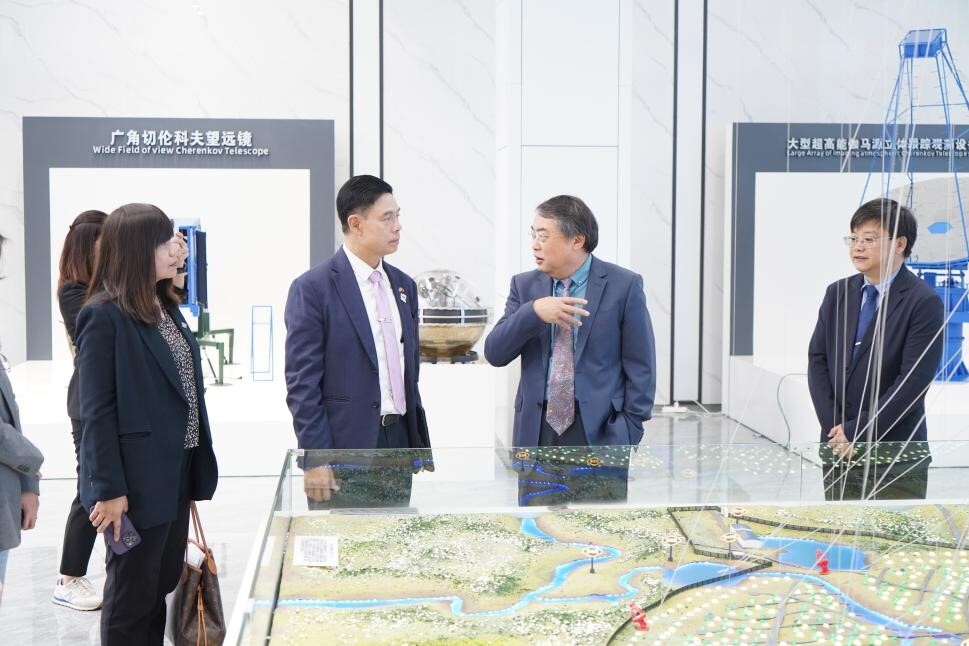
Academician Zhen Cao introduced the sand table model of LHAASO to President Pongruk Sribanditmongkol of CMU
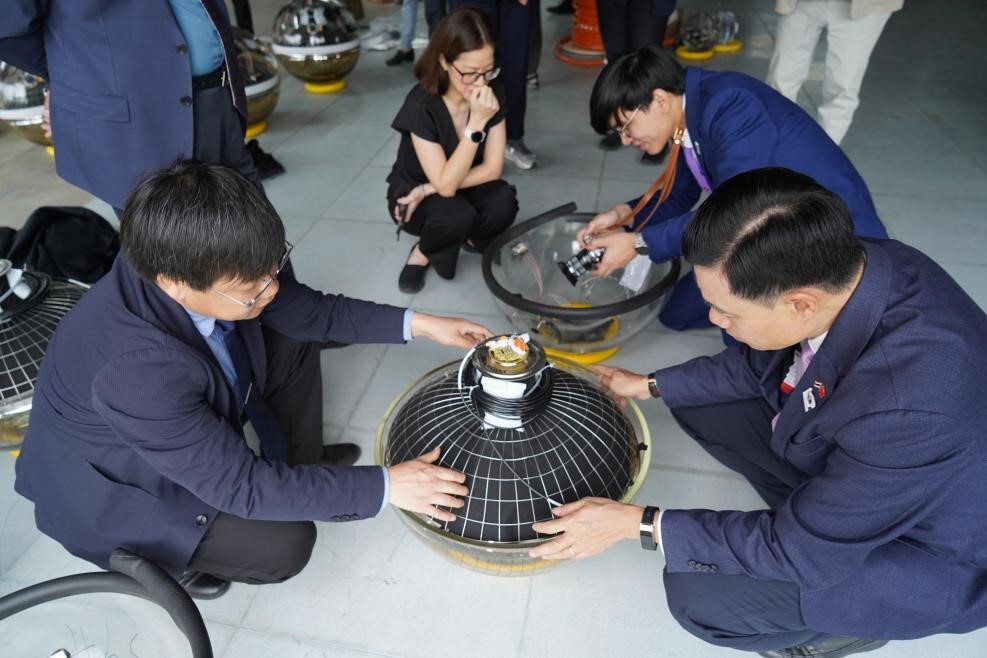
Prof. Mingjun Chen introduced the Baikal-HUNT detector units to the Thai team
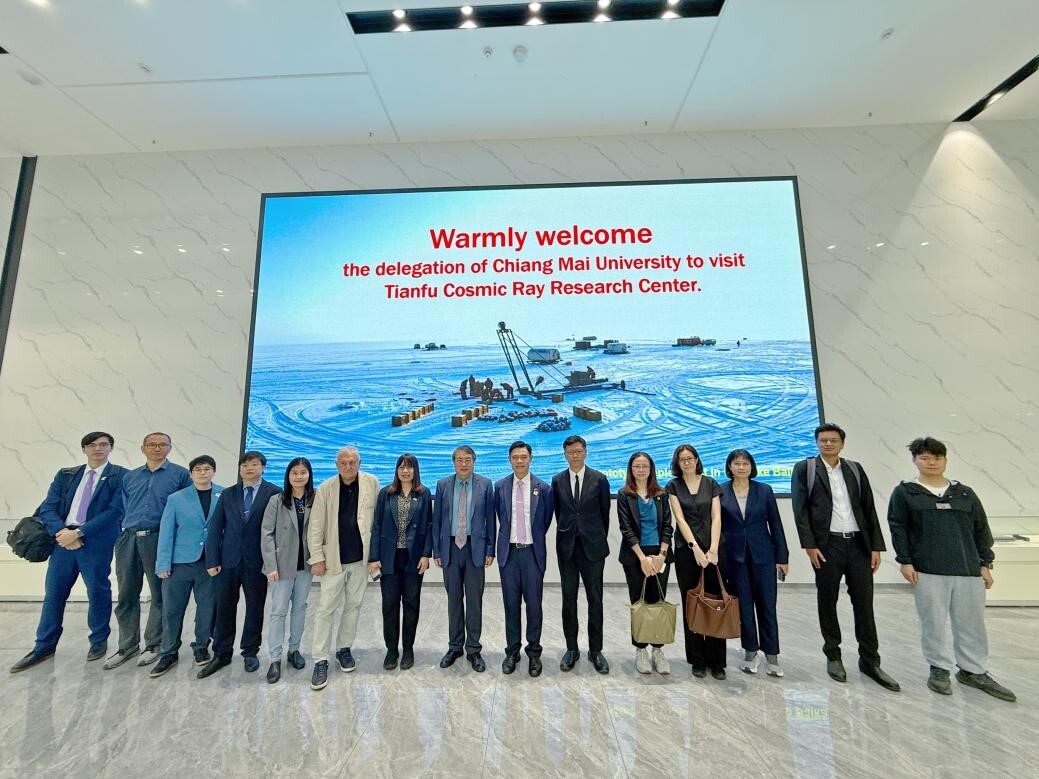
The Group Photo
