
On March 20, Prof. Cao Zhen, LHAASO’s chief scientist and an astrophysicist at the Institute of High Energy Physics (IHEP) of the Chinese Academy of Sciences, visited the INAF-Osservatorio Astronomico di Brera to present recent results from the LHAASO (Large High Altitude Air Shower Observatory) experiment, which he leads. The seminar, organized in collaboration with the ASTRI group, focused on the origin of cosmic rays, one of the most debated topics in high-energy astrophysics.
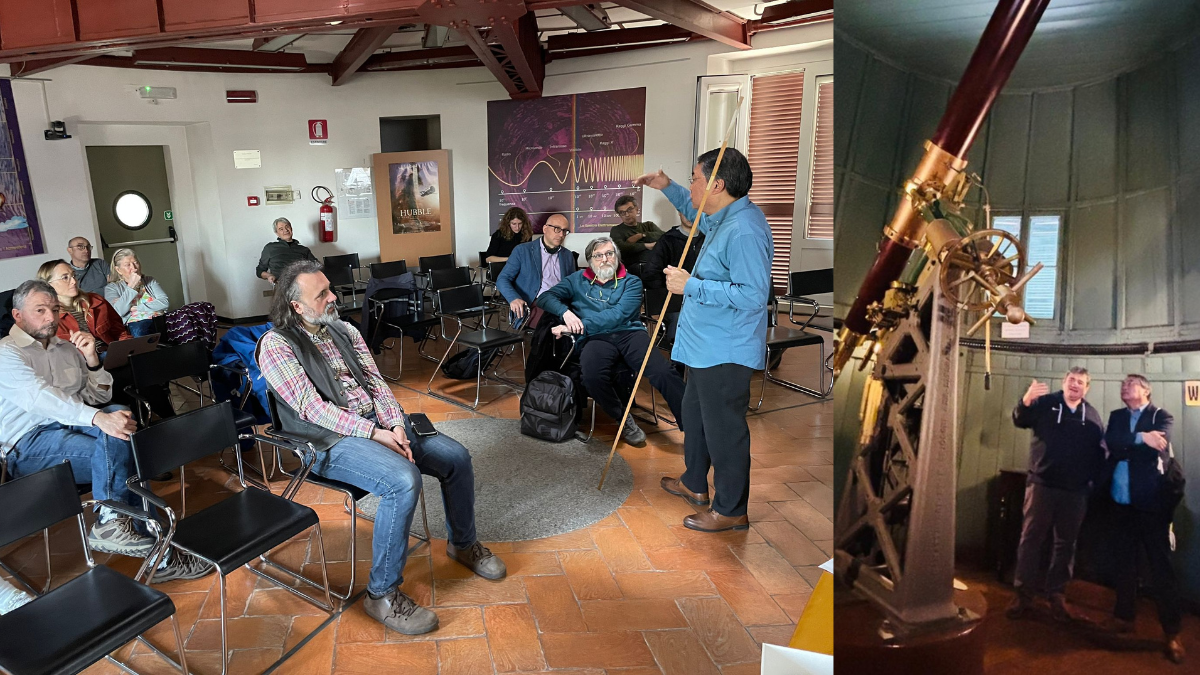
Prof. Cao Zhen during the seminar in the Cupola Fiore room of the Osservatorio Astronomico di Brera. Credits: INAF
Recent LHAASO observations have changed our view of the objects responsible for accelerating these particles. Supernova Remnants, long considered the main sources of cosmic rays, might not be the only accelerators involved. Instead, different types of astrophysical objects could be responsible for producing particles at the highest energies.
A key point of the discussion was the complementarity among three main projects, such as LHAASO, ASTRI, and, in the future, LACT (Large Array of Cherenkov Telescopes, which is currently under development at the LHAASO site), to study the origin of cosmic rays through ground-based gamma-ray observations.
LHAASO is an astro-particle high-altitude (4400 m) array experiment combining water Cherenkov detectors and stations of scintillators coupled to phototubes spread over nearly 1.4 km². Specifically designed to monitor the sky at the highest energies, it has been operating in Tibet, near the city of Daocheng, since 2019. It directly detects extensive air showers triggered by incoming cosmic rays and high-energy gamma rays across a broad field of view, enabling nightly sky monitoring and surveys. This allows high-flux sensitivity by accumulating events over long periods. Despite its large field of view (2 steradians), it has a relatively modest angular resolution on the order of 0.5°. Nevertheless, it detected dozens of high-energy gamma-ray sources emitting from a few TeV to a few PeV, very likely the “cosmic cauldrons” where cosmic rays are accelerated. However, the modest angular resolution of the experiment didn’t allow precise pinpointing of the astrophysical processes responsible for accelerating hadronic particles (the cosmic rays).
Therefore, the Chinese colleagues are now involved in setting up the LACT array, which will include up to 36 small single-mirror air-Cherenkov telescopes (6 m diameter). Their goal is to improve imaging capabilities and conduct detailed studies of sources that LHAASO has detected with poor angular resolution. The LACT array is being deployed at the LHAASO site to exploit the existing infrastructure. A challenge is the weather: during the summer months, the location is affected by the monsoon, making it nearly impossible to perform air-Cherenkov observations.
In parallel with these projects, the ASTRI Mini-Array is being developed at the Observatorio del Teide in Tenerife, utilizing nine innovative dual-mirror air-Cherenkov telescopes with a large field of view (>100 deg²). It aims to deliver high-resolution imaging of gamma-ray sources, making it especially suitable for detailed studies of the morphology and spectra of the highest-energy sources, such as those observed by LHAASO. ASTRI will begin science operations as early as summer 2026, and it will not be affected by adverse weather conditions due to the highly favorable location of the Canary Islands.
From detection to the identification of the emitters
One of the key messages emerging from the seminar is that detecting a source is only the first step. LHAASO has already found dozens of very-high-energy gamma-ray sources, including candidates for PeVatronic acceleration of cosmic-rays. However, its angular resolution does not allow scientists to resolve their internal structure. As Prof. Cao Zhen explained: “It’s like looking at the Moon with your naked eye: you can see bright and dark regions, but no details. With a telescope, you can resolve the structure of craters.”
This is exactly where ASTRI and LACT come into play. Their capabilities include tracking sources detected by LHAASO and studying them in detail to reveal their morphology and the physical mechanisms responsible for particle acceleration.
A shared sky
Another important aspect is that these instruments mainly observe the same region of the sky. “Being located at similar latitudes, we share the same sky and can observe the same sources.” Prof. Cao Zhen noted, emphasizing the natural synergy between the experiments.
This overlap may create ideal conditions for coordinated observations, when wide-field detection and high-resolution imaging are combined to build a more complete picture of the TeV Universe.
The partnership between ASTRI and LACT may be both scientific and practical. Due to high humidity, the Chinese site will experience significant observational limitations during the summer months, approximately from May to October. During this time, LACT operations might be paused. However, ASTRI is not affected by these constraints and can continue observing, effectively bridging the gap. Meanwhile, LACT will benefit from having more telescopes with higher sensitivity, especially during periods of ideal observing conditions. Together, these two facilities may offer a more complete and continuous coverage of the TeV sky, combining temporal and instrumental complementarity.
A vision for the future
Looking ahead, the discussion also touched on potential new forms of collaboration between the Italian and Chinese teams. As Prof. Cao Zhen pointed out, the idea may also be to exploit the time zone difference. Telescopes in one country could be operated remotely by researchers in the other, allowing observations to be carried out during daytime working hours. This approach would significantly reduce the need for night shifts, improving working conditions for scientists, while also encouraging closer collaboration between the two communities, even if it might require, as jokingly noted, a few language courses.
As Giovanni Pareschi (the ASTRI Principal Investigator) jokingly remarked, this vision could develop into what he called a “Marco Polo team”, a modern scientific link between Italy and China.
The discussion was highly productive, paving the way for future collaborative efforts between LHAASO, ASTRI, and LACT. By leveraging their combined strengths, these instruments will help create a more comprehensive view of the TeV sky and enhance our understanding of the origins of cosmic rays.
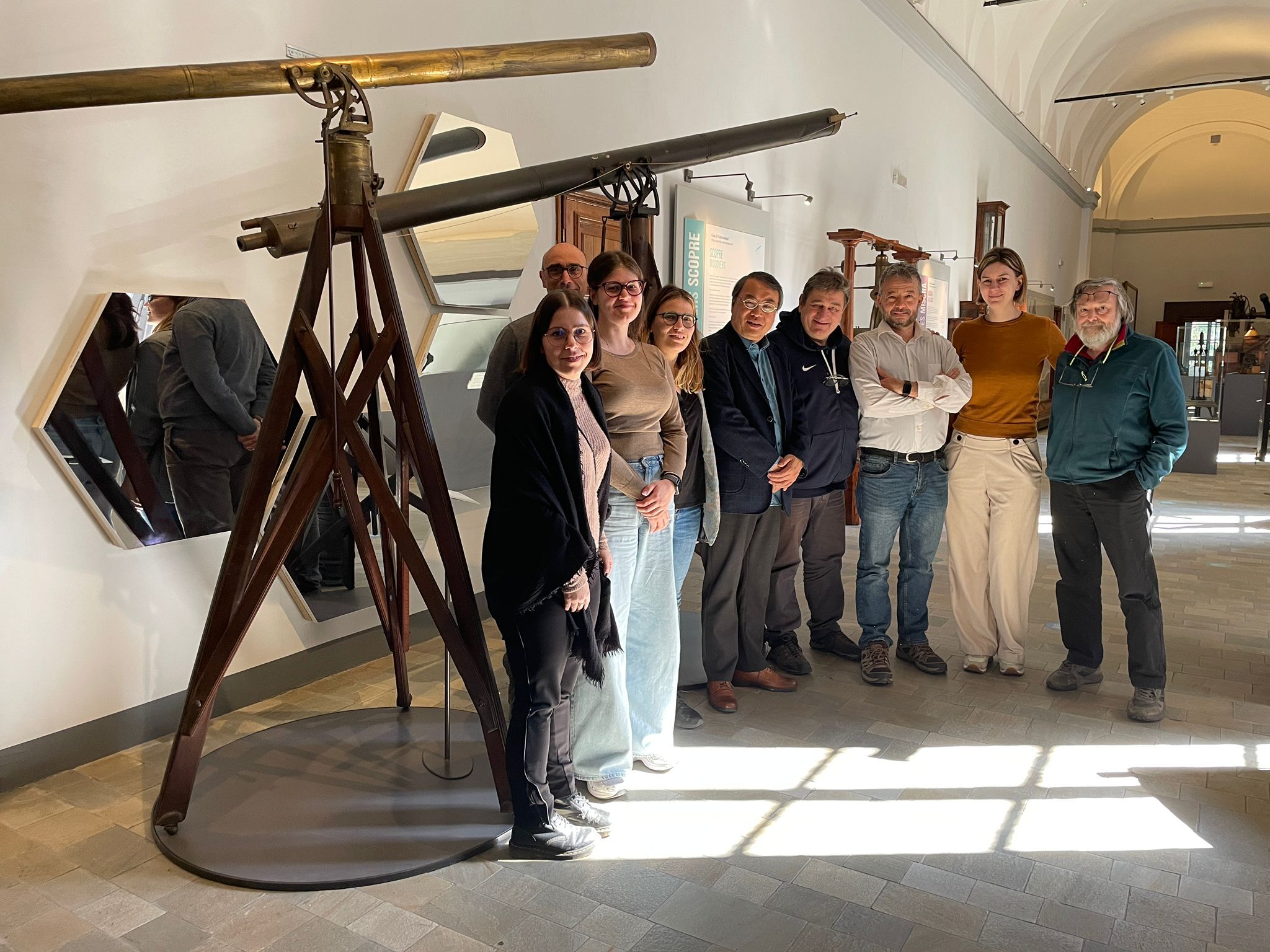
Prof. Cao Zhen at the Brera Astronomical Museum with scientists from the ASTRI Mini-Array team (from left to right: S. Anzuinelli, S. Scuderi, C. Quartiroli, S. Crestan, Prof. Cao Zhen, G. Pareschi, A. Giuliani, M. Rigoselli, S. Vercellone). In the background, a museum installation of mirror tiles from the ASTRI telescopes is beautifully displayed. Credits: INAF
ASTRI web site:https://www.astri.inaf.it/index.php/astri-lhaaso-and-lact-a-shared-view-of-the-tev-sky/2026/?lang=en
